
ARTICLES
Why Your Revenue Team Needs a Spine
Stability lives in the spine. Flexibility lives in the muscles. Why your core narrative has to bear weight without bending, where the adapting actually happens, and how to tell a heavy box from a load that should change the bone.
By Bruce Scheer, Inspire Your Buyers®
Your revenue team does not need a more flexible story. It needs a spine.
I know how that sounds coming from someone who spends his days telling revenue leaders their narrative is out of alignment. But the request I get most often after the diagnosis is the wrong one. The CRO nods, agrees the story has drifted, and then says: fine, so let’s make it more adaptable. Something the reps can flex to any buyer, any vertical, any bad Tuesday.
I grew up in a family of chiropractors, and there is a reason I keep calling myself a corporate chiropractor. The spine is the best teacher I know for this. If your spine were fluid, if it reshaped itself every time you shifted your weight, you would not be flexible. You would be on the floor.
A spine that bends every time the wind blows is not adaptable. It is broken.
The Big Problem: the fluid spine
Here is the pattern, and if you run a revenue team you have lived it.
A big deal goes sideways. The rep on it comes back with a theory: the buyer did not connect with the pitch, the story is too broad, we should lead with something else. The theory gets repeated in the pipeline review. By Friday the narrative has a new opening. Next month a different rep loses a different deal for a different reason, and the narrative moves again. Then a competitor announces something, marketing gets nervous, and the homepage changes the same afternoon.
None of these moves is unreasonable on its own. Each one is somebody responding to real feedback in good faith. Together, they turn the one thing your whole go-to-market body stands on into something nobody can stand on.
Every rep now works from whichever version was current the week they last paid attention. Marketing is on version nine. Customer success is on version four. Your champion, the person carrying your story into rooms you will never enter, is repeating whichever one they heard first.
That is a fluid spine. It feels responsive from the inside. From the outside, it looks like a company that does not know what it is.
The Risks: structural failure
A body reacts to a spine that will not hold, and it reacts before anyone in your building notices.
Your buyer notices first. Gartner found 69% of B2B buyers report inconsistencies between what a company’s website says and what its sellers tell them, and Gartner’s own analysts warn that this “creates mistrust, potentially putting the transaction at risk” (Gartner). Seven in ten buyers are already catching your surfaces disagreeing. When the spine moves every month, the surfaces cannot help but disagree, because each one was built on a different day.
Then the deal gets smaller. Buyers hit with too much conflicting information are 153% more likely to settle for a smaller, less disruptive purchase than they originally planned (Gartner). The buyer de-risks by buying less of you, and a story that keeps changing is the most conflicting information there is.
Then it reaches the profit line. System1 and the IPA tracked 56 brands over five years and found the ones committed to long-term message consistency were roughly twice as profitable as the ones that kept switching direction (System1 / IPA). Inconsistency bills you twice, once in the deals a wobbling story loses and again in the spend it takes to overcome your own noise.
And underneath all of it, the human cost. When a strong seller loses, their manager blames a misaligned strategy rather than poor execution 72% of the time (Corporate Visions and Florida State University, 2026). The managers already know. The reps are working twice as hard to compensate for a structure that will not hold them up, and the exhaustion gets filed as a performance problem.
That is what a fluid spine costs: revenue first, then trust, then margin, then the energy of the people trying to hold you upright.
The Desired Outcome: a body that stands up
Now picture the opposite.
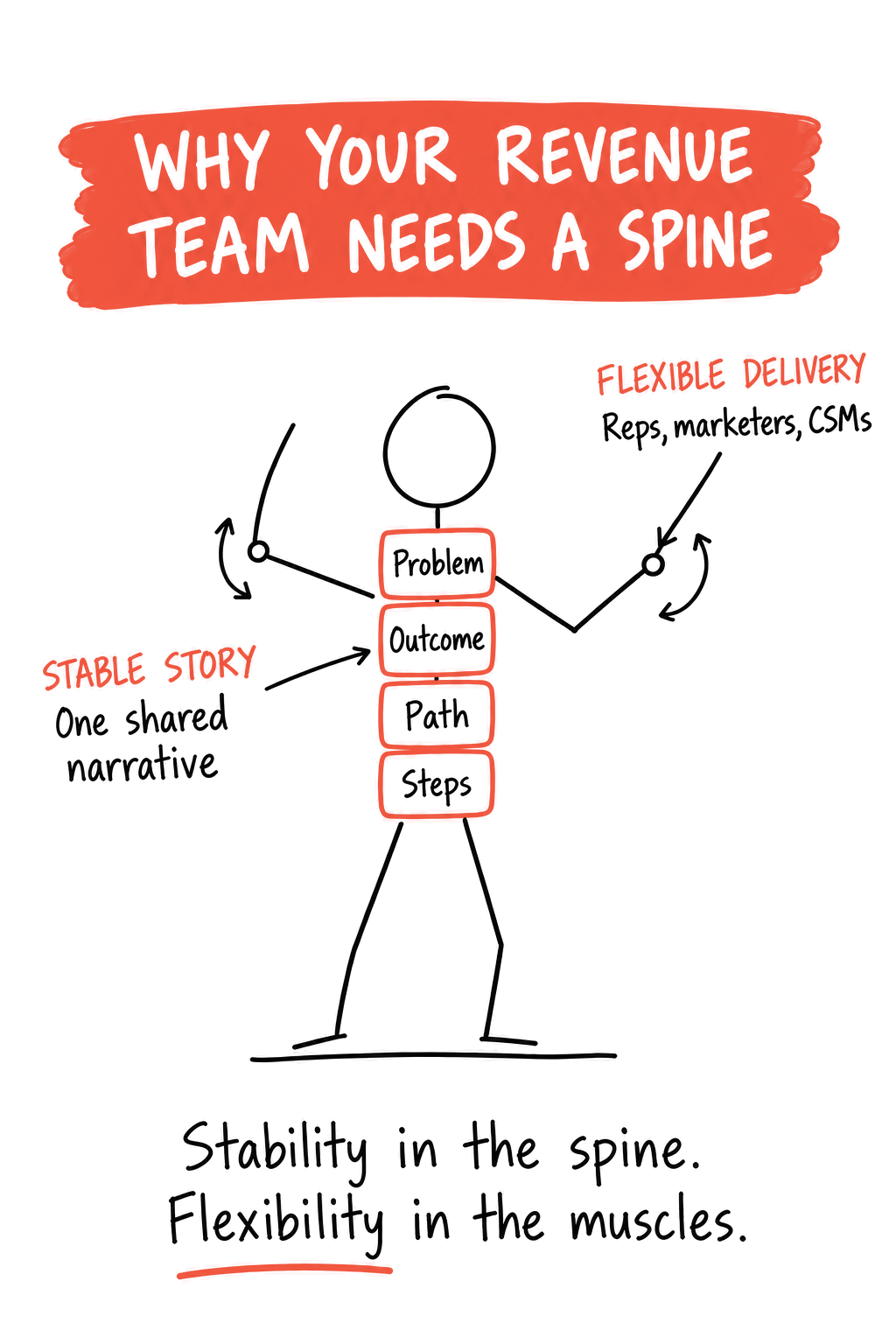
One narrative spine, built once on top of a position you have actually found, and then left alone. The Problem your buyer is in, the Outcome when it is solved, the Path through, and the Steps to take: four vertebrae, stacked, load-bearing. Marketing builds on it. Sales sells from it. Customer success renews against it. Nobody has to check which version is current, because there is one, and it has been the same one long enough that your buyers are starting to say it back to you.
And the field team is more flexible, not less. That is the part that surprises people, and it is the whole point of the anatomy lesson coming up.
This state is rare, which is exactly why it pays. Only 4% of companies say they have a clear, consistently understood value proposition. Those that do grew 19% in 2025, against 12% for companies with limited or inconsistently communicated ones (Bain & Company, 2026). The other 96% are working just as hard, while the ground under them keeps moving.
The Path: an anatomy lesson for revenue leaders
Four things I learned across the dinner table, translated.
1. The spine is load-bearing, and load-bearing things do not flex
The spine’s job is structural. It holds the body upright and it protects the central nervous system, the thing that carries every signal from the brain to the hands. In your company, that nervous system is the value you create for a specific buyer and the vision behind it. The narrative spine exists to protect that and to carry weight on top of it.
Your go-to-market body has real weight stacked on it. Quotas, a pipeline target, a board deck, a hiring plan. A spine can only bear that load if it stays where it is. The moment leadership treats the core story as something to reshape after one rough call, the reps lose the one thing they were counting on to stand up straight under the number.
Stability lives in the spine. It is supposed to be boring. Boring is what lets everything else move.
2. Flexibility lives in the muscles and joints
A stable spine does not mean a rigid body. Reach across a table for something right now. Your spine holds. The reach happens in your shoulder, your elbow, your wrist.
Your muscles and joints are the reps, the AEs, the marketers, the CSMs. Objection handling, tailoring to a vertical, reading a specific room, opening on a different vertebra depending on who is across the table: that is theirs, and they should have enormous range to do it. A CMO, an AE, and a CSM will each deliver the story the way their stakeholder needs to hear it, and none of them will contradict the other two, because they are all pulling on the same bone.
That range matters more than most leaders realize. Buyers spend only 17% of their purchase process meeting with potential suppliers, and when they are comparing several, any one rep may get 5% or 6% of it (Gartner). Your rep has a sliver of a window and has to reach a long way inside it. Reach without a spine is a pulled muscle. Reach from a spine is range.
So when your field team asks for flexibility, say yes. Then point them at the right part of the body.
3. Wolff’s Law, or when the bone should actually change
Here is the part chiropractors know and most revenue leaders do not.
Bone remodels. Wolff’s Law says bone grows and reshapes itself in response to the sustained forces placed on it. Lift a heavy box once and nothing happens. Carry weight the same way for months and the bone changes to meet it.
That is the rule for when the narrative should move. One lost deal is a heavy box. One rep’s theory about why is a heavy box. A rough quarter is, usually, a heavy box. None of them should reshape the spine.
A fundamental shift in the market is a load. A macroeconomic pressure your buyers cannot ignore. A competitor who changes the category, not just their pricing. A technology that makes your buyer’s old problem stop mattering. Those forces are sustained, they arrive from many directions at once, and they aggregate. When they do, the narrative has to remodel to carry the new reality, and refusing to let it is its own kind of structural failure.
The discipline is telling the two apart. Aggregate the signal before you touch the bone. If ten reps report the same objection across ten deals in one quarter, that is load. If one rep reports it loudly once, that is a box. Most narratives I see get rebuilt on boxes and left alone under real load, which is exactly backwards.
4. Misalignment, referred pain, and the adjustment
Now for the case where the bone should have remodeled and did not, or where three departments quietly built their own spines.
The organization starts to feel referred pain. My dad’s patients came in complaining about a stomach that turned out to be a back. Your pain shows up as longer sales cycles, discounts that started as exceptions and became policy, a pipeline that fills and never converts. The reps in the field are straining, working twice as hard to compensate for a crooked structure underneath them, and on the dashboard the strain reads as a talent problem.
A new deck does not fix that, and it will not evolve its way out on its own. It needs a deliberate adjustment: someone to assess where the load has shifted, find the misalignment between what you claim and what your buyer now values, and reset the spine so the body can move efficiently again. Then leave it alone and let the muscles work.
Diagnose the load. Adjust once. Hold.
Next Steps
If you recognized your own quarter in any of that, three things.
- Count your spines. Ask marketing, sales, and customer success to each write your core story in four sentences, without conferring. If you get three different skeletons, you have found the referred pain.
- Take the free Narrative Assessment. Seventeen questions, five minutes, no email required. It will show you whether your story is drifting from a stable spine or whether you never had one.
- If you suspect the load has actually changed and the bone has not, talk with me for thirty minutes. I will tell you plainly whether you are looking at a box or a load.
I would also love to hear where you land on this. Where does your team draw the line between the story that holds and the delivery that flexes? Find me on LinkedIn and tell me.
The strongest revenue teams I know are flexible because their flexibility has something to push against.
So the next time a deal goes sideways and someone wants to move the story, ask the question: is that a heavy box, or is it a load? And does your team have a spine to tell the difference?
Author
Bruce Scheer is the author of the Amazon bestseller Inspire Your Buyers®. He jokes that he has never worked a day in his life, and in that time he has helped thousands of marketers and sellers go to market with a more compelling story, for HP, Microsoft, SAP, Adobe, Oracle, Dell, Citibank, McKesson, Infosys, Unisys, Tableau, and Fastly. Connect with him on LinkedIn.
Research cited
- Gartner Sales Survey, 2025: 69% of B2B buyers report inconsistencies between the information on a company’s website and what its sellers tell them, which Gartner warns creates mistrust that puts the transaction at risk.
- Gartner, “Gartner Reveals New B2B Sales Approach to Win in Today’s Information Age,” July 29, 2019: buyers given too much contradictory information are 153% more likely to settle for a smaller, less disruptive purchase than they originally planned.
- Gartner, “The B2B Buying Journey”: buyers spend only 17% of their purchase process meeting with potential suppliers, and when comparing multiple suppliers, any one sales rep may get only 5% or 6% of it. Gartner has since rewritten the page; the figures are preserved in the Internet Archive capture of November 1, 2020.
- System1 and the IPA, “The Magic of Compound Creativity”: analysis of 56 brands and 4,000+ ads over five years; brands committed to long-term message consistency were roughly twice as profitable as those that kept switching direction. Industry-reported.
- Corporate Visions and Florida State University Sales Institute, “Sell with Agility,” 2026: when a strong seller loses, their manager attributes the loss to a misaligned strategy rather than poor execution 72% of the time.
- Bain & Company, 2026 B2B Growth Agenda: only 4% of companies say they have a clear, consistently understood value proposition, and those that do grew 19% in 2025 against 12% for the rest.
For more sourced, graded B2B statistics like these, see the 2026 B2B Statistics page.
Frequently asked questions
Should a B2B go-to-market narrative ever change? Yes, under sustained load, and only then. A lost deal, one rep’s objection, or a rough quarter is a heavy box: real feedback, but not a reason to reshape the core story. A macroeconomic shift, a competitor changing the category, or a technology that makes your buyer’s old problem stop mattering is a load. Aggregate the signal first. If the same pressure shows up across many deals and many quarters, the narrative should remodel to carry it.
How much should sales reps be allowed to adapt the story? As much as they need to, as long as the adapting happens in the delivery rather than in the spine. Objection handling, vertical tailoring, and choosing which beat to open on are the muscles and joints, and reps should have wide range there. What stays fixed is the buyer’s Problem, the Outcome, the Path, and the Steps. A CMO, an AE, and a CSM should each tell it their own way without contradicting one another.
How do I know if my narrative is misaligned or just needs more time? Look for referred pain. Longer sales cycles, discounting that has quietly become policy, and a pipeline that fills without converting are the symptoms of a structure that has fallen out of line with what buyers now value. If marketing, sales, and customer success each describe your core story differently, you are working from more than one spine, and no amount of adoption time fixes that.
What is the difference between a narrative spine and a sales script? A script tells everyone to say the same words. A spine gives everyone the same structure and lets them choose the words. Scripts break on contact with a real buyer because they cannot flex. A spine survives because the flexing happens around it, in the people delivering it, while the value story underneath stays the same across every team and every surface.