
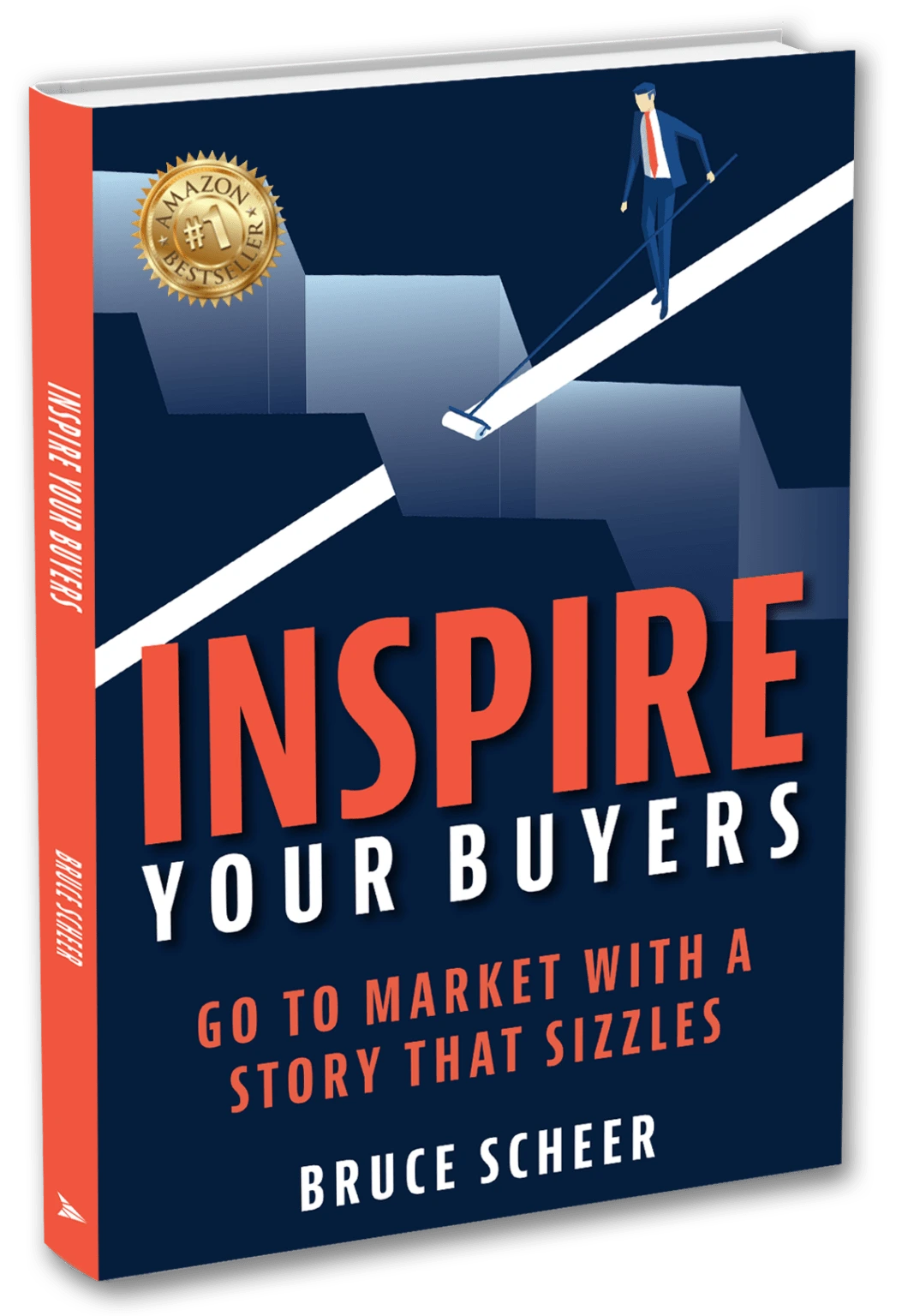
Inspire Your Buyers®
The book on building a go-to-market narrative your whole revenue team delivers the same way. 125 Amazon ratings, five-star average.
It's for leaders taking something new to market and the teams who have to sell it. It walks the four beats of a narrative spine, POPS, so product, marketing, sales, and success tell the same story, and it covers the visual side, because a champion can't carry a paragraph into the CFO's office. The same model built the narratives for HP, Microsoft, Tableau, and Fastly, among others.
Print length: 100 pages · Published March 24, 2023 · ISBN-13: 979-8987214800
What you’ll walk away with
- One story your whole revenue team delivers the same way, human and AI.
- A narrative your buyers repeat in the rooms you’ll never enter.
- The confidence to go to market once, and get it right.
Get the book
Reader ratings
★★★★★ 5 out of 5. 125 global ratings, 98% five-star. Readers call it practical, readable, clear, and simple.
What readers say
“Bruce hits a home run by merging best sales practices with storytelling and narrative in a way that will not only inspire buyers but re-energize your sales force.”
“As a former head of Procurement for Fortune 500 companies, I wish more of the salespeople I encountered adopted the approach outlined by Bruce. Those that do stand head and shoulders above their peers.”
“I worked with Bruce to develop go-to-market stories for Dell EMC and NetApp. He has a gift for a story that resonates with customers and is clear enough for sellers to deliver.”
“Worked with Bruce Across 4 companies. I have been directly involved in 4 engagements with Bruce and team and in my mind, he elevated yet again with this book and I loved reading the equation of PROBLEM then the OUTCOME and then and only then, the PRODUCT or SOLUTION to the problem. This is so well done that I think I can even turn skeptics into adopters. THIS is the way to build your message, your GTM motions, your website, your brand promise and so much more.”
Book FAQs
What is a go-to-market narrative?
A story you tell a buyer that shows them the problem they’re in, the outcome worth wanting, and how working with you gets them there. What makes it a narrative rather than a message is where it sits. It becomes the strategic backbone of your go-to-market strategy, so your website tells the same story your sellers tell, which is the same story your champion tells their CFO.
What framework does Inspire Your Buyers® teach?
Five moves, and the order is the whole point. Target the right buyers. Spotlight the Big Problem. Envision the Desired Outcome. Showcase the Big Solution. Prescribe Next Steps. Nobody cares about your solution if they don’t yet know they have a problem. The discipline most teams skip is naming each central theme in four words or fewer. The book works one hospital case all the way through to show what that looks like: underperforming clinician teams, better patient outcomes, experience without risk. On this site those four beats are called POPS, for Problem, Outcome, Path, and Steps.
Who is the book for?
Business, marketing, and sales leaders on the hook for revenue growth, and the teams who have to sell what those leaders just funded. The book states its own test plainly: if you’ve caught yourself thinking “I need a new message,” or literally, “our story sucks,” it was written for you.
Why does the book make the buyer the hero instead of the product?
Because casting yourself as the hero doesn’t sell. Most companies talk about the solution they built and the market leadership they claim. The book calls that a solution-centric orientation and puts the rule bluntly: always a Robin, never a Batman. Chapter one makes the case with a focus group. A participant who had already been through a sales cycle with the client and decided not to buy said what he heard the first time sounded nothing like this. Same company. Same needs. Same product. He called that day to restart the conversation and became a customer.
What is the North Star Messaging Model?
The development process behind the narrative, in five phases: Scan, Develop, Test, Refine, and Launch and Learn. Scan is the phase organizations skip. It gathers the outside view, meaning target customers, industry analysts, and a hard read of competitor messaging, alongside the inside view from the people who have actually sold to those buyers. Look only inward and you’ll write down what you already believe. The model has been refined and tested since 2000.
What is the SIZZLES framework?
Seven filters for a narrative you’ve already built: Structure, Insightful, Zippy, Zappy, Leading, Empathetic, and Sass. Run the story through each one and see what stays, what goes, and what’s missing. Zippy asks whether it floats without the bloat. Empathetic asks whether it shows buyers in the same situation who got out of it. Sass asks whether you sound like a partner or a vendor.
Can one narrative work across many products, verticals, and buyer personas?
Yes. That is the test of whether you found the right one. If you have to rewrite it to sell into manufacturing, it was never your narrative. The book works through the enterprise arm of Alcatel-Lucent, which had 460 products and no rep who could hold them all. The Big Problem was moving too slow. The Desired Outcome was dynamic enterprise. The Big Solution was dynamic communication framework. Tailoring it meant swapping a single word by vertical: dynamic government, dynamic hospitality. It stayed in use close to a decade, through several acquisitions.
Does this work for startups and scale-ups, or only large enterprises?
Both. The model was built inside industry giants including IBM, SAP, Microsoft, HP, Oracle, Google, Adobe, and Citibank, then refined with hyper-growth scale-ups including Concur, SuccessFactors, FinancialForce, and Tableau. A scale-up’s problem is standing apart from a crowded pack. A large enterprise’s problem is hundreds of products and dozens of buyer personas pulling in different directions. Same four beats, different pressure.
How long is the book, and how is it meant to be used?
One hundred pages, short enough to read in a sitting. Every chapter closes with three questions to run against your own business, so the second pass is slower than the first and worth more. There’s also a free narrative assessment on this site that the book points readers to as a safety check before you test a narrative with real buyers.
What formats is the book available in?
Hardcover, paperback, Kindle, and Audible.
Who wrote Inspire Your Buyers®?
Bruce Scheer, a go-to-market narrative strategist and keynote speaker, coached through Amazon’s narrative process during a global sales productivity initiative at AWS. He has been honing the Go to Market Narrative model since 1995.
See where your story is drifting today.
Seventeen questions, five minutes, no email required.