
HOW IT WORKS
You don’t have a messaging problem. You have a positioning problem.
Every team I meet wants better words. So they hire a writer, the words get prettier, and the deals still stall. You can't write your way to a value you haven't defined. Someone has to decide what you're worth to a specific buyer, why you beat the alternative, and get your leadership team to agree on it in one room. That's positioning. It's the hardest, most valuable work there is, and here's exactly how we do it together.
WHAT YOU WALK AWAY WITH
Find your value. Communicate it. Quantify it.
Three things have to be true before a high-consideration buyer says yes. They understand your value. They hear the same story from every person and every surface. And they can defend it to the people who hold the budget, in rooms you're often not in.
The full sequence builds all three, in that order. We usually develop positioning and narrative together, because a story is only as strong as the position under it. Business cases can come with them, later, or first.
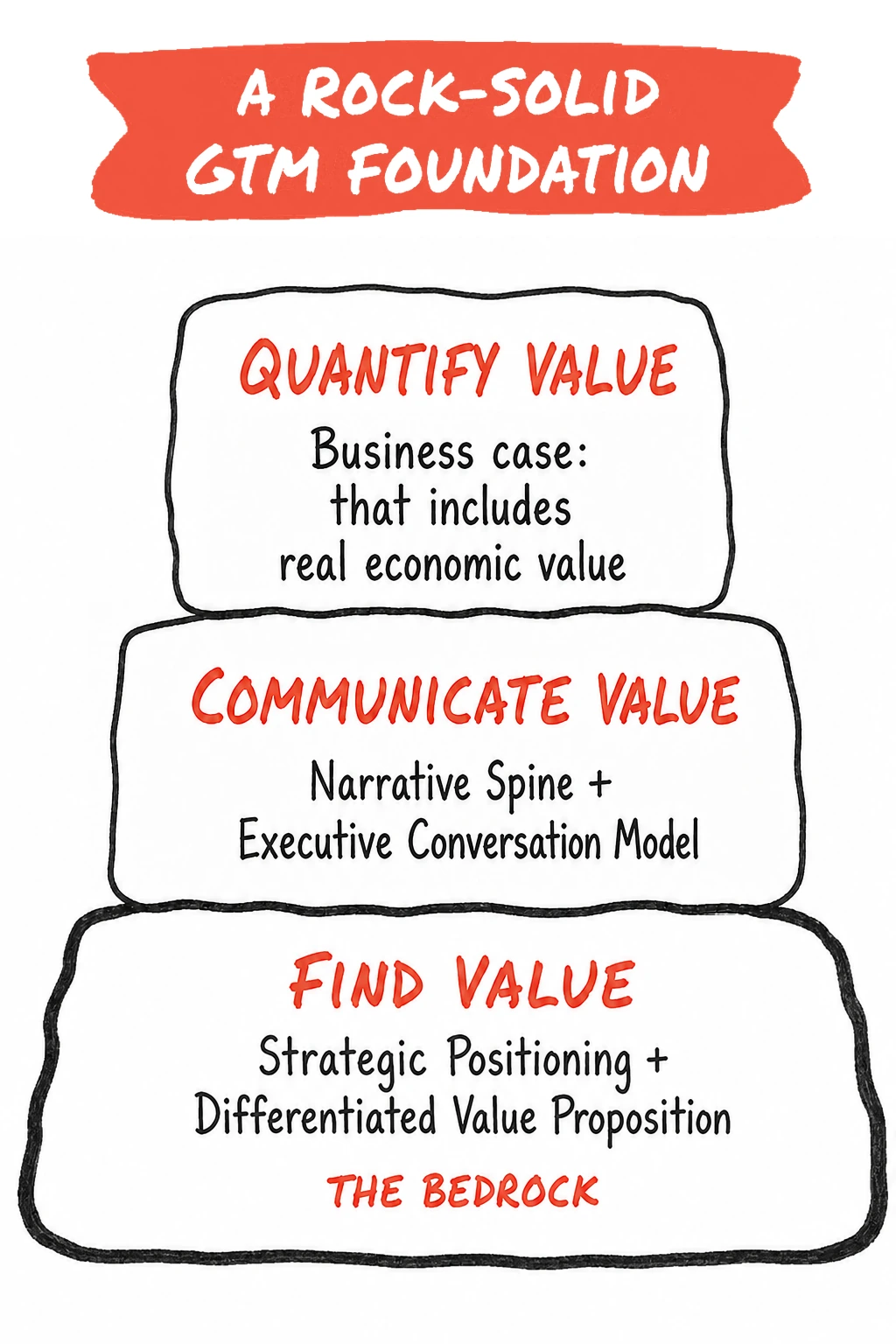
FIND VALUE
Strategic positioning and differentiated value. The bedrock.
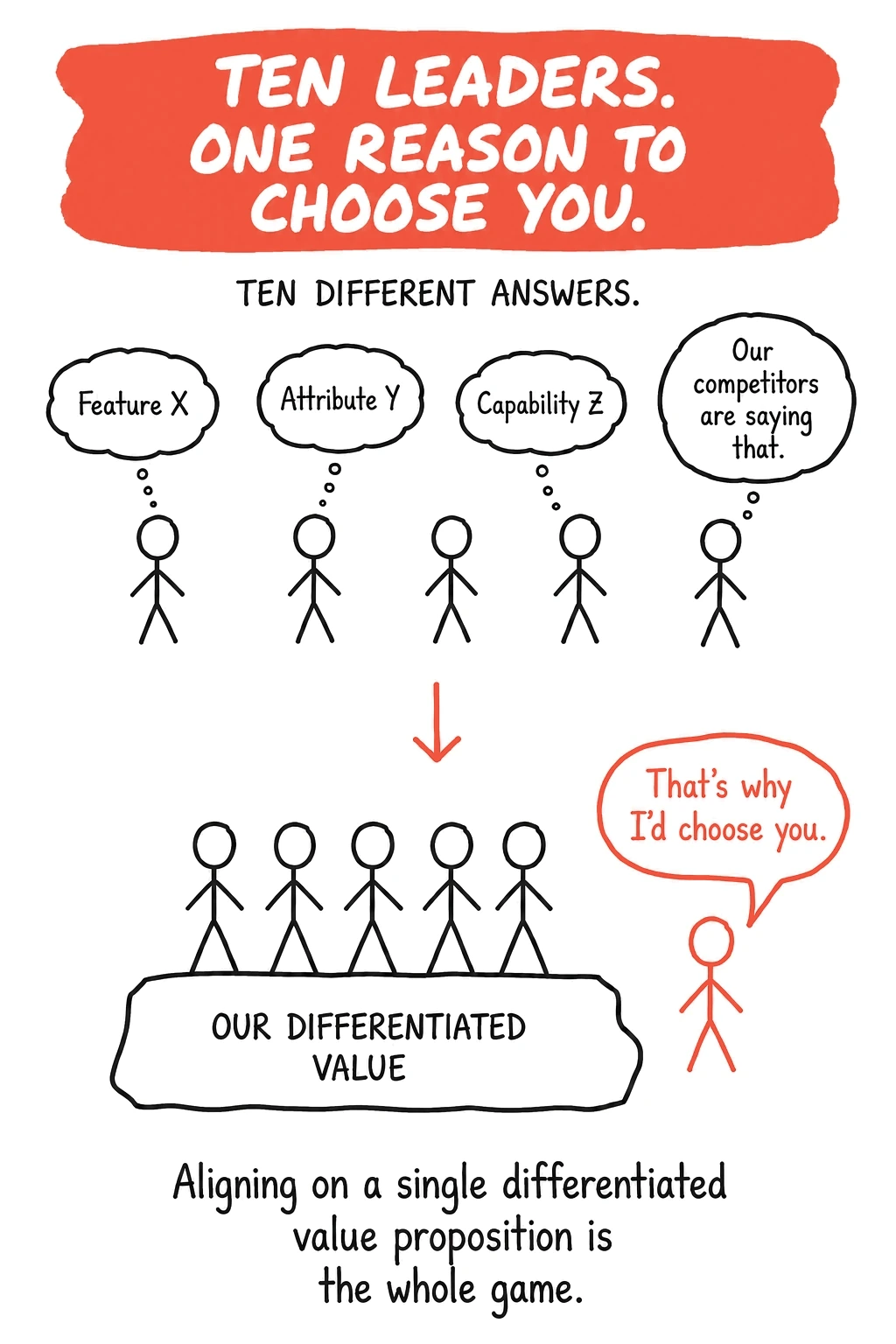
Finding your value is deciding, with conviction, what you're worth to a specific buyer and how you're different from what they'd do instead.
Bain found that 49% of companies surveyed named core product or service differentiation as their biggest value proposition challenge (Bain & Company, 2026). That's why we start here. Getting to one differentiated value proposition is the whole game.
COMMUNICATE VALUE
The narrative spine and the executive conversation.
69% of B2B buyers already see a gap between what a company's website says and what its sellers say (Gartner, 2025). That gap is Value Dissonance™, and it's why deals quietly die.
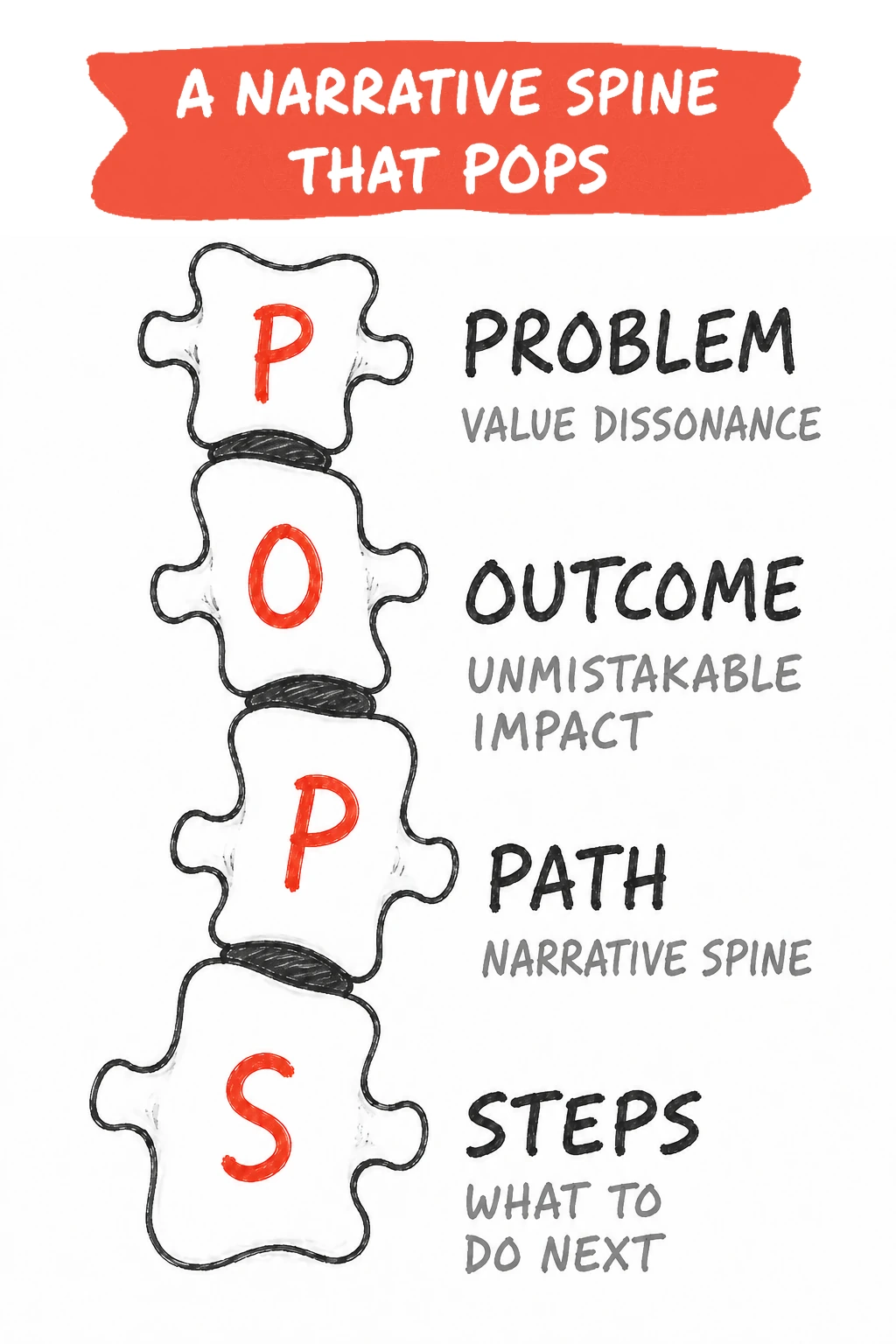
So once you've found your value, we give it a spine. POPS: Problem, Outcome, Path, Steps. The problem worth solving, in the buyer's words. The outcome when it's solved. Everything it takes to succeed, the honest version, so the buyer can defend it. Then the steps to buy, because there are two sales: the yes, and the approval cycle your champion survives without you.
Then we make it a conversation. APROPOS is our seven-beat model for the live executive meeting, and we draw it, because a champion can't carry a paragraph into the CFO's office. They can carry a picture.
QUANTIFY VALUE
The business case, built for every buyer.
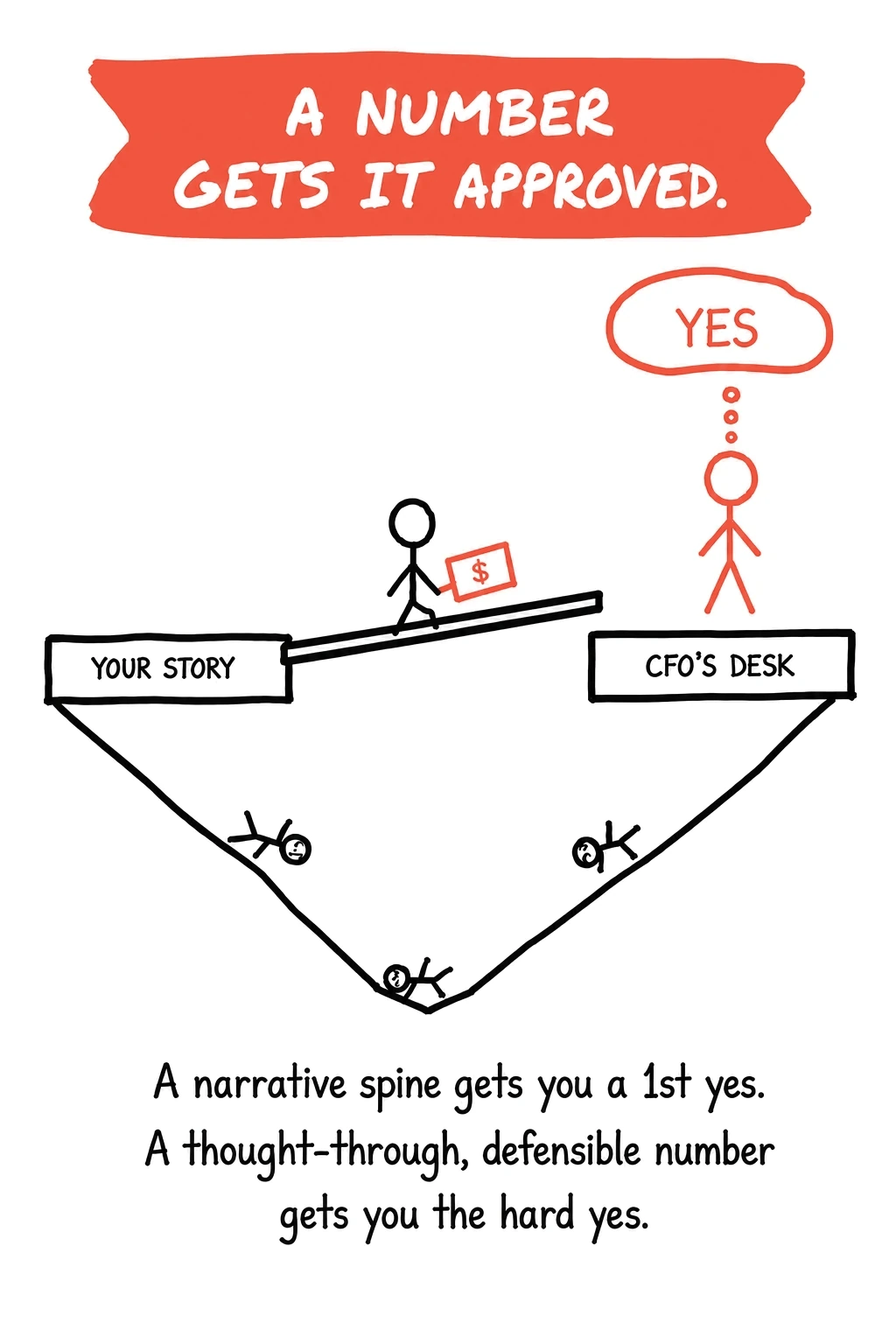
A narrative moves the buyer. A number gets it approved. With our partner ValueNavigator, a seller enters a target prospect and the solution they want to sell, and gets a researched, prospect-specific first draft of the value narrative, business case, and financial analysis in minutes. The seller and buyer then refine and validate it together, with every assumption visible and every input editable, so the buyer will defend the number when you're not in the room.
HOW WE WORK
The North Star Model.
Kickoff, then five phases. Run since 2000. It doesn't end at launch. What you learn in the market feeds the next round, so the narrative gets sharper instead of stale.
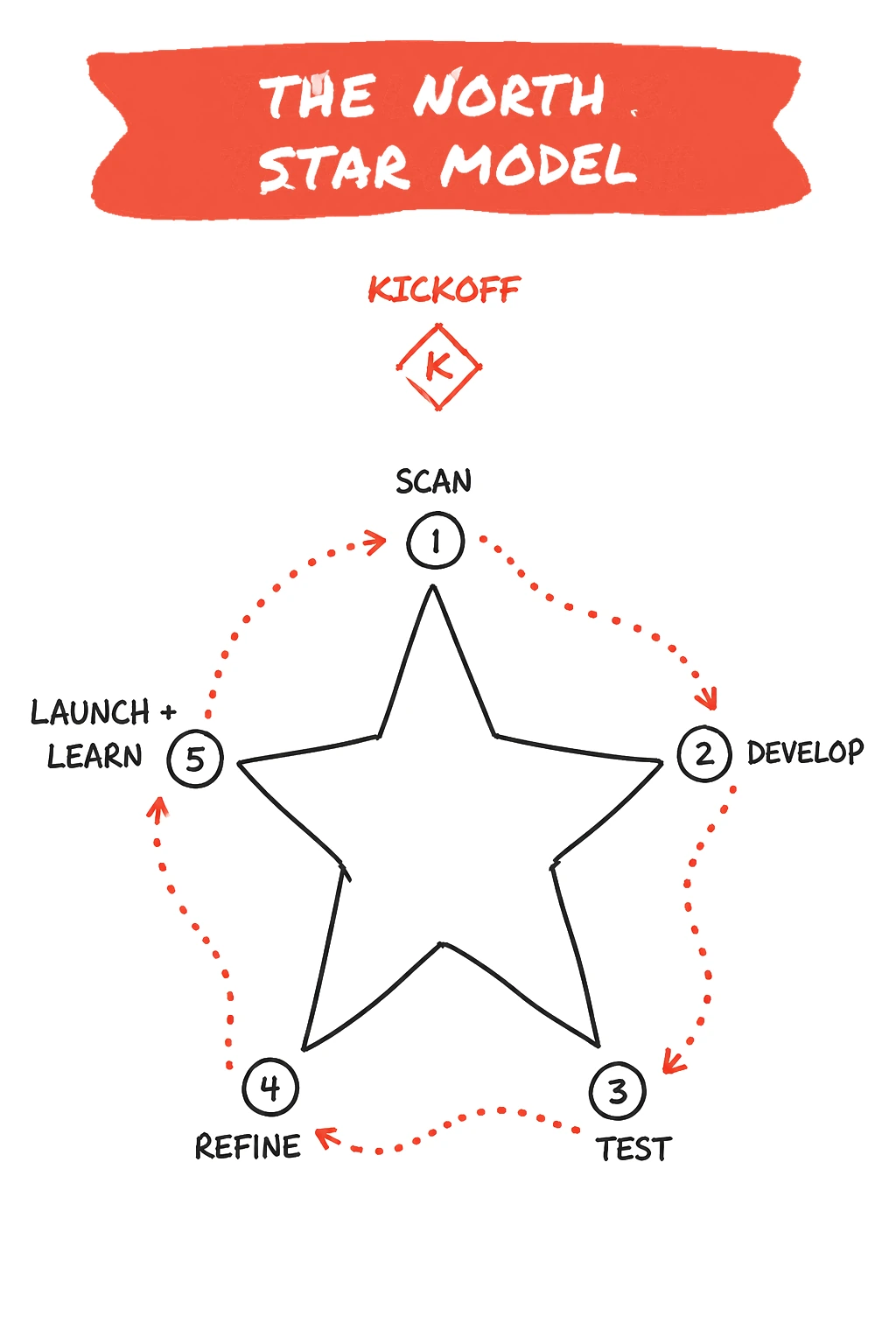
Kickoff
We align before the work begins: the aspiration, the problem, the risks, the path, and the steps this engagement will take. We run the kickoff on the exact model we build for you.
Scan
Market and category research, executive interviews, and a review of what buyers actually hear today, from call recordings and win/loss interviews where you have them.
Develop
Working sessions where Find, Communicate, and Quantify get built, in the room, with your leadership team. This is where ten private versions of the story become one.
Test
Around ten conversations with target buyers, advisors, partners, and the sellers who'll carry it. A safety check, not a study. We've never run it without learning something that mattered.
Refine
Small changes, high leverage. Tighter, truer, more repeatable.
Launch & Learn
We train your managers and reps to deliver it, with the Narrative Practice Partner, an AI they rehearse against before every meeting that matters, then run quarterly tune-ups on adoption and fidelity. Most firms skip this phase. It's where impact happens.
WHAT YOU WALK AWAY WITH
The process produces the insight. These are what the insight becomes.
Strategy filed in a binder changes nothing. Every engagement ends with six finished pieces your team uses the next morning, and every one of them is sized so you know exactly what you're getting.
Positioning & Narrative Canvas
One page.
Your whole position on a single page: who it's for, what they'd do instead, why you win, and the four beats of the story. The value is in what's not on it. A position that needs a second page isn't decided yet. This is the page your leaders sign.
Positioning & Narrative Spine Playbook
Eight slides.
The six positioning decisions, one per slide: market, competition, unique capabilities, differentiated value, target customers, category. Then the spine itself: Problem, Outcome, Path, Steps. This is the source document. Every deck, page, script, and AI agent that comes after it inherits from here, so nobody has to make it up again.
Market Validation
Ten conversations.
Before you bet a launch on the story, we put it in front of ten people who matter: target buyers, advisors, partners, and the sellers who'll have to carry it. Then we tell you what they said, what to keep, and what to fix. Most firms hand you words and hope. We check. We've never run this once without learning something that mattered.
Narrative Presentation & Whiteboard
Ten slides and one drawing.
The story in the two forms a seller actually needs: ten slides for the meeting, and one picture they can draw on a whiteboard from memory. A champion can't carry a paragraph to the CFO. They can carry a picture. This is that picture.
Narrative Conversation Guide
Ten slides.
How the story works across a table instead of on a page. Built on APROPOS, our model for the live executive conversation: the questions to open with, the beats to hit, the objections you'll get, and how to leave with the second sale already set up, the one your champion has to make without you.
Narrative Practice Partner
An AI practice partner, loaded with your spine.
Reps rehearse the narrative against a live buyer persona and get scored on every beat. Managers see who's carrying the story and who's drifting. And it's just in time: a rep with a meeting next Tuesday drops in the prospect's name, company, and LinkedIn profile, and rehearses against that executive before the real one. With a key executive you get one at bat. No more winging it. Rehearse the swing, then hit it out of the park.
Keep it sharp.
A narrative carried changes everything, so the work can keep going after launch. Marketing launch support carries the spine across every surface a buyer touches before a seller does, homepage included. Sales enablement support trains managers first, then reps, so the story is coached, not just distributed. Quarterly reviews and tune-ups check adoption, fidelity, and market movement, four times a year. Narratives don't go stale on their own. They go stale because nobody checked.
YOUR INVESTMENT
Before you hire another senior rep to carry a story nobody agreed on, fix the story.
Two more senior sellers and another $250K of pipeline won't convert any better than the last $250K if they're carrying ten versions of your value. Fix the spine once. Everyone you hire after that inherits it.
Every tier gets all six deliverables. What changes with size is how many leaders have to agree, how many surfaces the story has to cover, and the scale of the launch.
Early Stage
Under $10M in annual revenue or total funding raised.
$50,000
About four weeks
Growth Stage
$10M to $100M in annual revenue or total funding raised.
$75,000
About six weeks
Enterprise
$100M+ in annual revenue or total funding raised.
$100,000
About eight weeks
Early-stage teams run this in about four weeks. Growth-stage in six. Enterprise in eight, because there are more leaders, more surfaces, and worse calendars. Either way, it ends with a launch, not a binder.
Start where you are.
Positioning and narrative. We recommend them together; every tier above includes both. If you already have a strong foundation in one, we'll scope a focused engagement on the other.
ValueNavigator. Scoped and priced separately, based on your product and team size. Add it to the engagement or start with it. Many teams do. When you're ready, positioning and narrative give every business case the same differentiated story.
WHO’S IN THE ROOM
Nobody defends language they were handed.
Product owns what the thing does and what it will do next.
Marketing carries the story across every surface a buyer touches first. Why sales and marketing alignment is a narrative problem.
Sales carries it into the rooms where deals are decided, and will tell you in ten minutes whether a claim survives a real buyer.
Success hears what the buyer believed at signature and what turned out to be true.
On the CEO: come to the kickoff and the readout. In between, your presence changes what people are willing to say.
See where your story is drifting today.
Seventeen questions, five minutes. It shows you where your value is leaking and what it's costing you.
Take the Narrative Assessment Read the book on the flight there →