Inspire Your Buyers®

SCENARIOS · NEW MERGER OR ACQUISITION

Two companies. Two stories. One Monday morning.

The deal closes on paper. It closes again, or fails to, the first time a buyer asks one of your sellers what the combined company does.

THE PROBLEM

A body cannot run on two spines

The Monday after the announcement, a customer calls. A seller from one side picks up and describes the new company one way. An hour later a seller from the other side describes it another way. Both are loyal to the story they were hired on. Both are reasonable. The customer hears a company that does not know what it just became.

Each company came into the deal with a spine: a way of naming the buyer’s problem, the outcome, and the path to it. The combined company now has two. Two leadership teams, two decks, two websites, two sets of sellers, and one buyer comparing notes across all of them. We call what that buyer feels Value Dissonance™: the clash when everyone representing you describes your value differently.

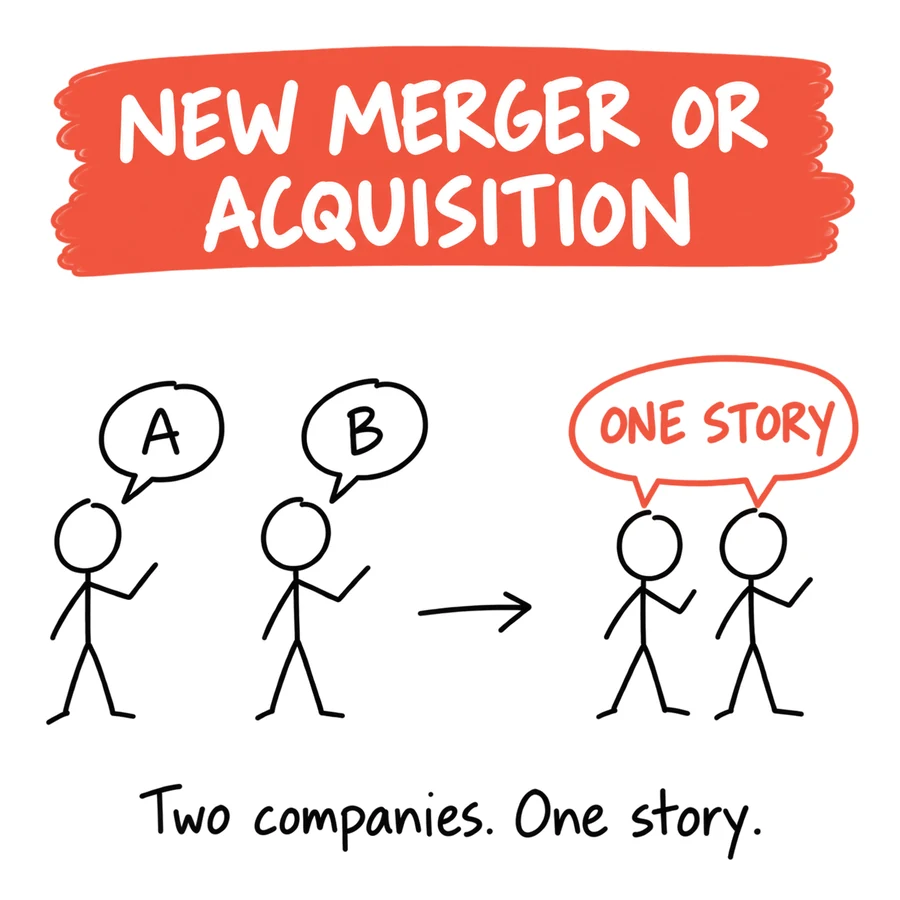
Hand drawn sketch titled New Merger or Acquisition. Two stick figures stand apart, one saying A and the other saying B. An arrow leads to the same two figures side by side, sharing one speech bubble that says One Story. Caption: Two companies. One story.

A few years back I worked with a company Adobe was about to acquire. I talked to 10 different leaders, and I got 10 different answers. We put those ten leaders in a room and hammered out one answer. That answer is what they took into the acquisition.

That was one company. A merger starts you at twenty.

Read the story in Narrative Is the New Moat →

Is this you?

  • The announcement is drafted, and it describes the deal rather than what changes for the buyer.
  • Each side’s sellers are still opening with their own deck.
  • Ask leaders from both companies why a buyer should choose you now, and the answers do not match.
  • Cross-sell is in the deal model and nobody can say the cross-sell story in one line.
  • Customers of the acquired company are asking whether their product has a future.

WHAT THE PROBLEM COSTS

Buyers notice before the integration team does

Integration plans cover systems, org charts and comp plans. The story usually waits its turn. Buyers do not wait.

69%

69% of B2B buyers report inconsistencies between the information on a company’s website and what its sellers tell them. Gartner’s own analysts warn this “creates mistrust, potentially putting the transaction at risk.”

Source and our read

153%

Buyers hit with too much contradictory information are 153% more likely to settle for a smaller, less disruptive purchase than they originally planned.

Source and our read

74%

74% of B2B buying teams demonstrate “unhealthy conflict” during the decision. Buying groups ran from five to 16 people across as many as four functions, and groups that reached consensus were 2.5x more likely to report a high-quality deal.

Source and our read

4%

Only 4% of companies surveyed reported a strong, clear and consistently understood value proposition. Companies with clear, consistently understood value propositions reported 19% revenue growth in 2025, compared with 12% for those with limited or inconsistently communicated ones. This is an association, not evidence that clarity caused the growth difference.

Source and our read

See every figure, graded by source →

WHY NOW

The clock started at the announcement

Day one has a date. So does the first joint sales kickoff, the first combined price list, and the first renewal where a customer of one company gets pitched the other’s product. Each of those is a moment a buyer tests the story.

Miss the dates and the silence gets filled. Each side tells its own version, customers repeat whichever one they heard, and within a quarter those versions have hardened into how the market describes you.

THE OUTCOME

One company, from the first call

Picture the same Monday with the work done. The customer calls, and whichever seller picks up, from whichever side, names the same problem, the same outcome and the same path. The customer hangs up knowing what the combined company is for and what it means for them.

Inside, the two leadership teams defend one story because they built it together. Cross-sell has a sentence. The announcement, both websites and the renewal call agree with each other. The deal thesis the board approved is now something a buyer can repeat.

THE PATH

One positioning, then one story

We start outside, with the market both companies now share. What are buyers doing today instead of buying from you, including nothing? Who feels the problem and can act on it? What category do you belong in now? What is the value worth in the customer’s dollars? Only then do we look inward, at what the combination can do that neither company could alone. Most merger messaging starts and stops with that last question.

Then the narrative spine: Problem, Outcome, Path, Steps. Leaders from both sides build it together, in one room, because nobody defends language they were handed. The team that just got acquired will defend it least of all.

Then we test it with real buyers from both customer bases before it reaches a slide, and align every surface to it: the announcement, both websites, the seller conversation, the renewal call.

THE STEPS

Three steps, two of them this week

  1. Measure the gap

    Ask leaders from both sides to take the Narrative Assessment separately. Seventeen questions, five minutes each. The gap between their answers is your starting point.

    Take the Narrative Assessment

  2. Ask one question on both sides

    In your next integration meeting, ask each leader to write down, without conferring, why a buyer should choose the combined company. Read the answers aloud.

  3. Tell me what just changed

    The deal, the date, and who has to be in the room. I will tell you what the work would look like.

    Start the conversation →

QUICK ANSWERS

Questions we get

When should positioning work start in a merger or acquisition?

Before close if confidentiality allows it, and as early after close as you can if it does not. The announcement sets the first version of the story in buyers’ minds. After that you are correcting a story, which is harder than telling one.

Whose story wins, the acquirer’s or the acquired company’s?

Neither, if the deal was worth doing. The combined company can do something neither could alone, and that is the story. Picking a winner tells half your sellers and half your customers that their half is going away.

How is this different from the integration communications plan?

A communications plan decides who hears what, and when. Positioning decides what is true about the combined company’s value. The first without the second is a schedule for saying nothing in particular.

Can we do this ourselves?

The framework is in the book, and some teams do. What is hard to do in-house after a deal is be neutral. Every internal facilitator came from one side, and the other side knows it. An outsider can ask both leadership teams the same question and put the answers next to each other without anyone losing face.