
Inspire Your Buyers®

SCENARIOS · NEW CAMPAIGN

A campaign amplifies your position. Make sure you have one.

The planning meeting starts with channels, budget and dates. Somewhere in the second hour someone asks the real question: what are we saying to this market that nobody else is?

THE PROBLEM

Random acts of content, on a schedule

Revenue teams think in campaigns. A quarter, a theme, a budget, a pipeline target. It is how the work gets planned, and it is usually the moment the gap shows. The brief asks for the key message, and the room offers the same three lines that are already on the website, which are the same three lines on your competitors’ websites.

The campaign goes out anyway. It gets a theme and a tagline, an agency makes it handsome, and it produces activity. Marketing runs one story, sales keeps telling another, and the leads that come in hear both. That is random acts of content with a media budget. The campaign had nothing underneath it to amplify.

What the room was really saying in that planning meeting: we need a new market point of view. That is a positioning job, and a campaign brief cannot do it.

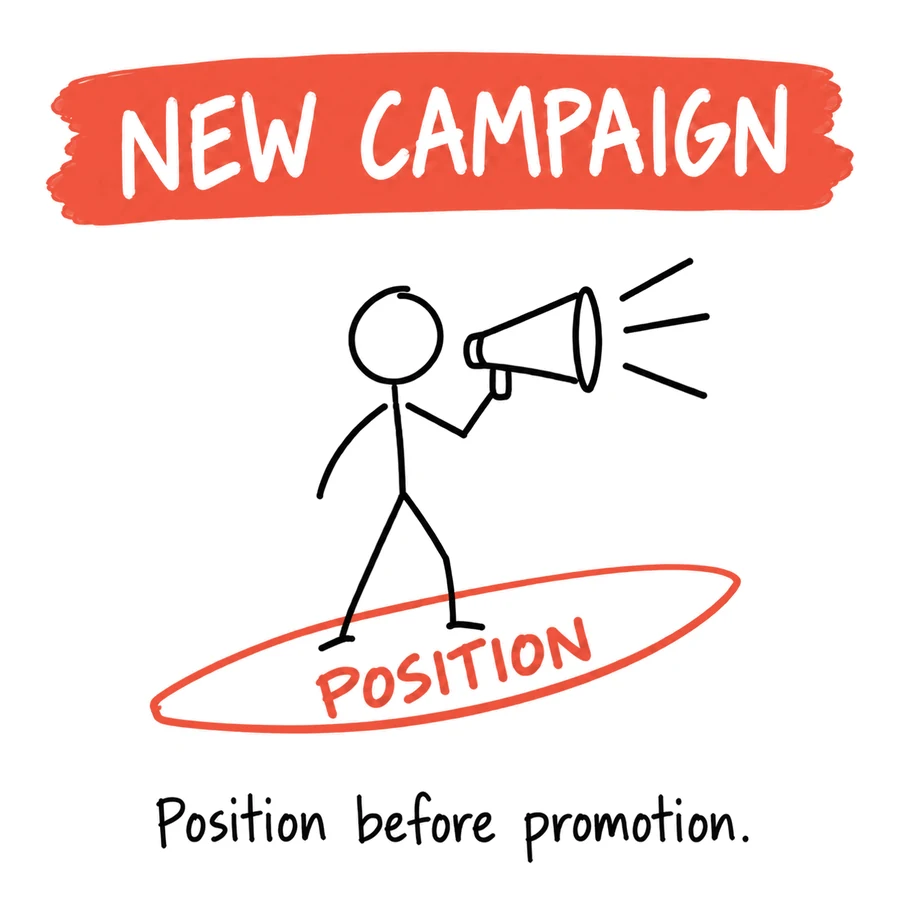
Hand drawn sketch titled New Campaign. A stick figure with a megaphone stands on a platform labelled Position. Caption: Position before promotion.

Unisys’s new narrative, People Computing, tested well with buyers and sellers. Then the CEO saw it, hated it, and said so, loudly. Our champion called me, crushed. I asked three questions. Had he shown the CEO the buyer validation? The seller excitement? The analyst reaction? No, no, and no. He went back with the evidence and one line: this wasn’t designed with you in mind, because you’re not the buyer. The CEO fell in love with it and used it to position the whole company.

“Bruce and his team seriously delivered the goods with our new message strategy and story. Their work was instrumental in helping us launch and grow new service lines across multiple verticals.” Laura Osburnsen, VP Marketing, Unisys.

Testing is how a narrative survives the most senior skeptic in the building.

See the Unisys story →

Is this you?

  • The campaign brief has channels, dates and a budget, and the message line is still blank.
  • The theme could run under a competitor’s logo.
  • Sales has not seen the campaign and will not change what they say because of it.
  • Every quarter’s campaign starts from a blank page.
  • Someone in the planning meeting said “we need a new point of view,” everyone agreed, and nobody owned it.

WHAT THE PROBLEM COSTS

A campaign cannot outrun its position

Spend makes a clear position louder. It makes an unclear one more expensive.

64%

64% of B2B buyers cannot distinguish one brand’s digital experience from another’s.

Source and our read

2x

Brands committed to long-term message consistency were roughly 2x more profitable than those that constantly switched direction.

Source and our read

69%

69% of B2B buyers report inconsistencies between the information on a company’s website and what its sellers tell them. Gartner’s own analysts warn this “creates mistrust, potentially putting the transaction at risk.”

Source and our read

4%

Only 4% of companies surveyed reported a strong, clear and consistently understood value proposition. Companies with clear, consistently understood value propositions reported 19% revenue growth in 2025, compared with 12% for those with limited or inconsistently communicated ones. This is an association, not evidence that clarity caused the growth difference.

Source and our read

See every figure, graded by source →

WHY NOW

The calendar will not wait for the story

The campaign has a launch date, and the date is tied to a pipeline number. Skip the position and you will still ship something. It will cost the same, and it will be built on the lines you already had.

That deadline is also the opportunity. A campaign is the best forcing function a positioning project ever gets: a date, a budget, an audience, and a room of people who need an answer.

THE OUTCOME

One point of view, everywhere the buyer looks

Picture the campaign with a position under it. It opens with a problem your market recognizes and has not heard named that way. The ad, the landing page, the webinar and the first sales call all tell the same story, so a buyer who clicks on Tuesday and takes a meeting on Thursday hears one company.

Sales helped build the story, so they use it. The next campaign starts from the same spine with a new angle, and so does the one after that. Consistency compounds. Nobody starts a quarter from a blank page.

THE PATH

Position first, then the spine, then the brief

A market point of view comes from outside. What is changing in your buyers’ world? What are they doing about the problem today, including nothing? Who feels it and can act? What category are you in, and what is the value worth in their dollars? Then the inward question: what can you do that the alternatives cannot? The point of view sits where those answers meet: something true about the buyer’s world that you are better placed than anyone to say.

Then the narrative spine: Problem, Outcome, Path, Steps. That spine is the campaign’s message architecture, and it is also the sales conversation. One piece of work, two uses.

Then brief the campaign from the spine, and test the story on real buyers before the media spend tests it for you.

THE STEPS

Three steps, two of them this week

  1. Check that marketing and sales agree

    Have your marketing and sales leaders take the Narrative Assessment separately. Seventeen questions, five minutes each. If their answers differ, the campaign and the sales call will too.

    Take the Narrative Assessment

  2. Put one question to the brief

    Read your campaign’s key message and ask: could a competitor run this line? If the answer is yes, the campaign is not the thing to fix.

  3. Tell me what is on the calendar

    The campaign, the date and the market. I will tell you what can be done before it launches.

    Start the conversation →

QUICK ANSWERS

Questions we get

Is this campaign messaging?

No. It is what campaign messaging is built on. A campaign needs a theme, copy and creative, and an agency or your own team is the right place for that. What they need from you first is a position and a point of view. Without one, the most talented writer in the world can only make your sameness sound better.

What is a market point of view?

A claim about the buyer’s world that is true, that they have not fully considered, and that you are well placed to make. It is about them. In an experiment Corporate Visions ran with Dr. Zakary Tormala of the Stanford Graduate School of Business, a pitch that opened with a problem the buyer had not considered scored about 10% higher on attitudes and choice than versions carrying the same offer.

Should sales be involved in a marketing campaign?

From the start. A campaign hands its leads to a conversation. If the seller tells a different story from the one that earned the click, the buyer notices: 69% of B2B buyers report inconsistencies between a company’s website and what its sellers tell them (Gartner, 2025). Build the story with sales in the room and the handoff stops being a change of subject.