Inspire Your Buyers®

SCENARIOS · NEW COMPETITOR

When buyers can’t tell you apart, the gorilla wins.

A new competitor shows up, or an old one gets serious. It might be the incumbent everyone knows, or an AI-native startup with a lower price. Either way your sellers start hearing a new sentence: how are you different from them?

THE PROBLEM

Sameness defaults to the safe choice

When two vendors sound alike, the buyer does not flip a coin. They pick the one that is easier to defend internally: the bigger name, or the lower price. If you are neither, a me-too story is a losing story, however good the product is.

The usual response makes it worse. Sellers reach for a feature comparison, marketing publishes a battlecard, and the conversation moves onto the competitor’s ground, feature by feature, where the gorilla has more of everything. You are now helping the buyer compare you, when the job was to change what they compare.

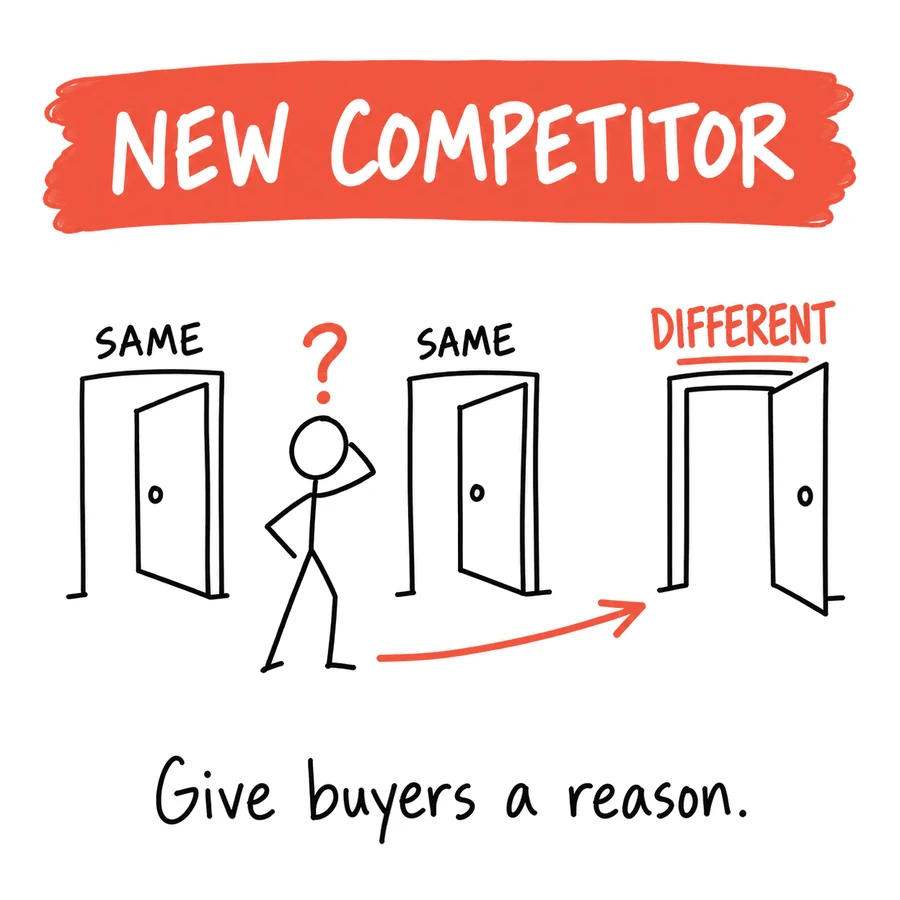
Hand drawn sketch titled New Competitor. A puzzled stick figure stands between two doors marked Same, with an arrow leading to a third open door marked Different. Caption: Give buyers a reason.

Brocade was up against the eight-hundred-pound gorilla with a newer technology, and needed sellers who could quantify the automation value. We built a value-selling tool reps actually adopted, including the number one seller in the building: the CEO.

A business case nobody can operate is not a business case.

See the Brocade story →

Is this you?

  • Sellers are hearing “how are you different from them?” and answering with features.
  • Discount requests are rising and the loss reason is price.
  • Your battlecards are longer than your story.
  • The competitor’s language is turning up in your buyers’ RFPs.
  • Your website could carry their logo and few would notice.

WHAT THE PROBLEM COSTS

What sameness costs

The research is blunt. Most buyers cannot tell vendors apart, and the most common way of selling is the one that loses most.

64%

64% of B2B buyers cannot distinguish one brand’s digital experience from another’s.

Source and our read

18%

Sellers who lead with product features, price, and discounts win only 18% of their deals, the lowest win rate of the four strategies studied.

Source and our read

48% vs 18%

Top-performing sellers use vision or perspective selling, narrative-led and insight-first, in 48% of their deals, versus just 18% for underperformers.

Source and our read

49%

Nearly half of companies say their biggest value proposition problem is core product or service differentiation. Bain calls that an existential issue, not a communications one.

Source and our read

See every figure, graded by source →

WHY NOW

Every quarter you wait, their framing sets

A competitor with momentum is also teaching your market how to think about the category: what matters, what to measure, what good looks like. The longer their framing goes unanswered, the more your sellers have to argue against it before they can make their own case.

Your own team feels it first. Discount requests climb, reps start leading with price, and your best people start asking what the plan is.

THE OUTCOME

The comparison happens on your ground

Picture the next competitive deal. Your seller opens with a problem the buyer recognizes and had not fully sized. By the time the competitor comes up, the buyer is already using your words for what matters. The capabilities only you have are on their requirements list.

Your champion walks into the buying committee with a number the CFO can check and a story they can retell without you. The gorilla is still bigger. The buyer now has a reason to choose you anyway, and can defend it.

THE PATH

Change what the buyer compares

Positioning against a competitor starts with the buyer, and the competitor comes second. What problem is the buyer trying to solve, and what are all the ways they could solve it, including the gorilla and including doing nothing? Who feels the problem most? Which category gives you the advantage? What is the difference worth in the customer’s dollars? Then the inward question: what can you do that the alternatives cannot?

Then the narrative spine: Problem, Outcome, Path, Steps. A strong Problem does the competitive work for you. If the buyer accepts your definition of the problem, the capabilities only you have stop being features and become requirements.

Then quantify it. Against a bigger name, your champion needs a number the CFO can check, because “we liked them better” does not survive a buying committee.

THE STEPS

Three steps, two of them this week

  1. See where your story leaks

    Take the Narrative Assessment. Seventeen questions, five minutes. It shows you where your value is leaking and what that is costing you.

    Take the Narrative Assessment

  2. Run the logo test

    Read your homepage and your first-call deck with the competitor’s name swapped in. Mark every line that still works. Those lines are doing nothing for you.

  3. Tell me who showed up

    The competitor, the deals you are losing, and what your sellers say when asked how you are different. I will tell you what the work would look like.

    Start the conversation →

QUICK ANSWERS

Questions we get

Should we name the competitor in our story?

Rarely. Naming them makes the conversation about them and tells the buyer who the standard is. Name the problem instead, defined in a way that makes your strengths the requirement. Your sellers still need to know the competitor cold. The buyer just should not hear about them first from you.

What if the competitor really does have a better product?

Then positioning matters more. Better at what, and for whom? No product is best for every buyer and every problem. Positioning is the choice of the buyer and the problem where your difference is real and worth money. If there is no such buyer, that is a product strategy problem, and it is cheaper to learn it in a workshop than in the pipeline.

Is this just competitive messaging?

No. Competitive messaging answers “why us and not them?” Positioning changes the question the buyer is asking. Battlecards sit downstream of it, and they get a lot shorter once it is done.