
Tableau was scaling fast and the story wasn’t. We ran a design workshop with thirty-three people in it, and the CPO, CMO, head of enterprise sales, commercial sales leader, and head of enablement all put their fingerprints on the narrative. It became the company’s onboarding, then its ever-boarding. The CEO came to the rollout and came back for the tune-up.
SCENARIOS · NEW GO-TO-MARKET MOTION
The story that got you here won’t get you into that room.
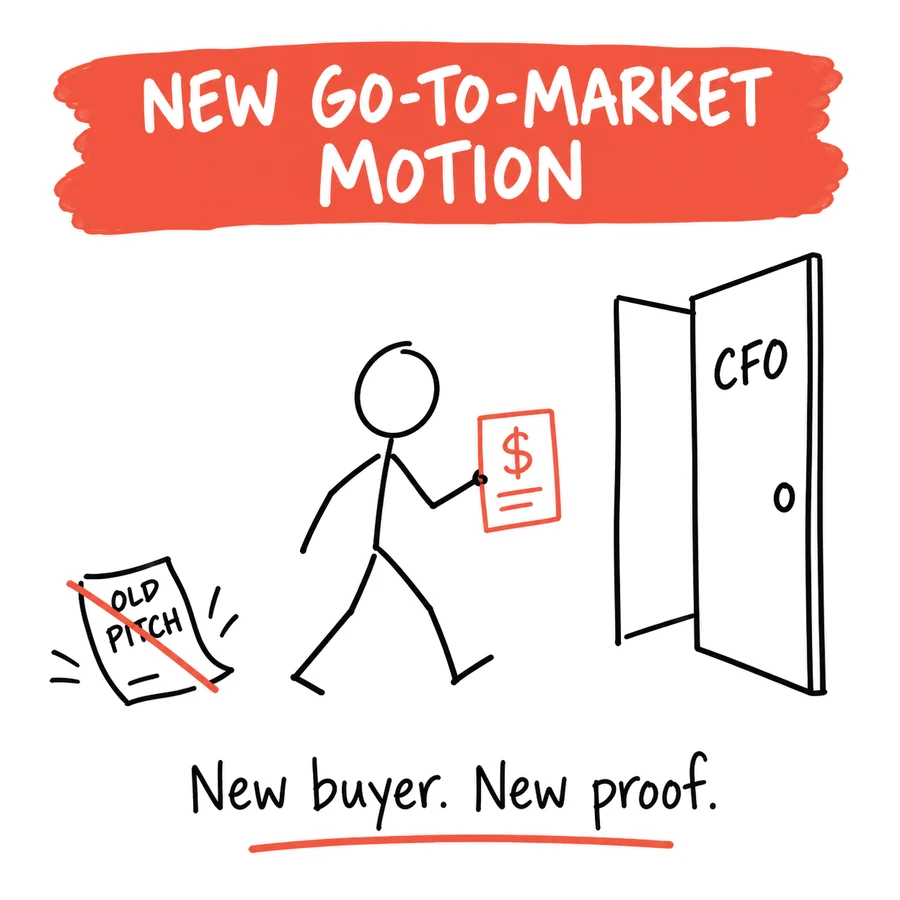
Moving upmarket, into enterprise, or into a new vertical is a decision about who you sell to. The story, the proof and the numbers that worked on the last buyer were built for the last buyer.
The narrative spine for this scenario
- Problem You are selling to a new kind of buyer with a story built for the old one.
- Outcome A story your champion can take into rooms you will never be in, and that holds up in Finance review.
- Path Reposition for the new buyer, outside-in. Build the spine for an executive audience. Quantify it so a CFO can check it.
- Steps Find out whether your leaders describe the new buyer the same way. Then test the story on one.
THE PROBLEM
Bigger buyers, more rooms, same deck
The motion changes and the story does not. The pitch that won a team lead in a short cycle now has to win a buying group. Gartner’s 2025 survey found buying groups of five to 16 people across as many as four functions, most of whom you will never meet. A vertical move does the same thing sideways: new language, new proof, new reasons to care.
What usually happens: sellers take the old deck into the new room, and when value gets hard to defend they fall back on product depth. The champion likes you and cannot retell it. Finance asks for proof that does not exist. Nobody says no. The deal just stops, because when buyers cannot defend the value internally, no decision is the safest decision.
From the work
Is this you?
- Deals are getting bigger on paper and slower in practice.
- Your champion loves you and the deal still dies in a meeting you were not in.
- Finance is asking for proof or numbers you do not have.
- Sellers retreat to the demo when an executive joins the call.
- Your case studies all come from the segment you are trying to leave.
WHAT THE PROBLEM COSTS
Most of the decision happens without you
The further upmarket you go, the less of the buying you are present for, and the more your story has to do alone.
17%
When B2B buyers are considering a purchase, they spend only 17% of that time meeting with potential suppliers. When they are comparing multiple suppliers, the time spent with any one sales rep may be only 5% or 6%.
74%
74% of B2B buying teams demonstrate “unhealthy conflict” during the decision. Buying groups ran from five to 16 people across as many as four functions, and groups that reached consensus were 2.5x more likely to report a high-quality deal.
56% / 44%
Between 40% and 60% of deals are lost to buyers who say they intend to buy and then do not act. Of those losses, 44% came from a preference for the status quo and 56% from indecision, the fear of making a mistake. When sellers answer indecision by selling the pain of the status quo again, the authors report that they make the customer more indecisive, “degrading win rates by 84%.”
4 vs 8
Successful sales meetings with C-suite executives averaged four seller questions. Unsuccessful but qualified meetings averaged eight. In general discovery, Gong’s separate analysis of 519,000 calls (2017) found 11 to 14 targeted questions did best, so the executive room runs on different rules. A lab study points the same way, though it reports no figures: B2B professionals shown data and an insight before a question paid more attention, and responded more positively, than those asked the question first (Dr. Carmen Simon, B2B DecisionLabs with Zoom).
WHY NOW
The pipeline will tell you, late
Long cycles hide the problem. A story that does not work upmarket shows up as deals that slip a quarter, then another. By the time the pattern is undeniable, you have spent several quarters of hiring and quota on it.
The board approved the move on a growth thesis. The sooner the story fits the new buyer, the sooner you find out whether the thesis holds.
THE OUTCOME
It holds up in rooms you never enter
Picture your champion in the budget meeting. They name the problem in the business’s terms, show the outcome, and walk the CFO through numbers with assumptions the CFO can check. Someone from IT asks a hard question, and the answer is already in the story. You are not there. It holds.
Your sellers open executive meetings with a point of view, where they used to open with discovery questions. New hires on the enterprise team learn one story. The vertical team tells the same spine with its own proof.
THE PATH
Reposition for the buyer you want
Start outside, in the new buyer’s world. What problem do they have at their scale, or in their industry, and what are they doing about it today, including nothing? Who feels it and can act, and who else has to agree? Are you in the same category up here, or a different one? What is the value in their dollars, which are bigger and more scrutinized? Then inward: what can you do for this buyer that the alternatives cannot? The honest answer is sometimes different from the one that won your current customers.
Then the narrative spine, Problem, Outcome, Path, Steps, written for an executive audience and built by the leaders of every team that will sell it: the enterprise team and the team that got you here. Each stakeholder gets their own proof. They do not each get their own story.
Then quantify it. A business case with transparent assumptions is what lets a champion win a room you are not in. And test the story on real buyers from the new segment before you hire against it.
The six ingredients of positioning → See how the work runs →
THE STEPS
Three steps, two of them this week
-
Check your leaders
Have the leader of each selling team take the Narrative Assessment separately. Seventeen questions, five minutes each. Where their answers differ, the new buyer will hear it.
-
Call one buyer who went quiet
Pick one buyer from the new segment whose deal stalled. Ask what they told their colleagues you do. The gap between their version and yours is the work.
-
Tell me where you are headed
The segment, the buyer, and what the last few deals did. I will tell you what the work would look like.
QUICK ANSWERS
Questions we get
Do we need a different story for enterprise buyers?
You need the same spine told at a different altitude. The problem, outcome and path should hold from your smallest customer to your largest. What changes is the scale of the problem, the proof, the numbers, and who has to agree. Two unrelated stories, one per segment, is how a company ends up contradicting itself on its own website.
How do you reduce no decision in bigger deals?
Make the value defensible by someone who is not you. Matthew Dixon and Ted McKenna report in Harvard Business Review that between 40% and 60% of deals are lost to buyers who say they intend to buy and then do not act, and that more of those losses come from indecision than from a preference for the status quo. A champion with a clear story and numbers a CFO can check has what they need to get a group to yes.
Should each stakeholder get tailored messaging?
Tailored proof, yes. Tailored stories, no. Gartner found that content tailored to individual stakeholders has a 59% negative impact on buying group consensus, while content relevant to the whole group improves consensus by 20% (Gartner Sales Survey, 2025). Give the committee one story to agree on.