
Inspire Your Buyers®

SCENARIOS · NEW PRODUCT

One launch. One first impression.

A launch has a date, a room full of buyers, and one first impression. The product will be ready. The question is whether the story will.

THE PROBLEM

The product got a roadmap. The story got a deadline.

Most launches run the same way. Engineering builds for months. Then, a few weeks out, someone asks for the messaging, and the people closest to the product write it. What comes out is accurate and complete: what it is, what it does, how it differs from the last version. It is a story about the product.

Buyers were not waiting for your product. They are busy with a problem, or have not noticed they have one. A launch story that opens with the product asks them to work out why they should care, and most will not. Meanwhile your sellers, handed a feature list, each build their own version of the pitch. One launch, a few dozen stories.

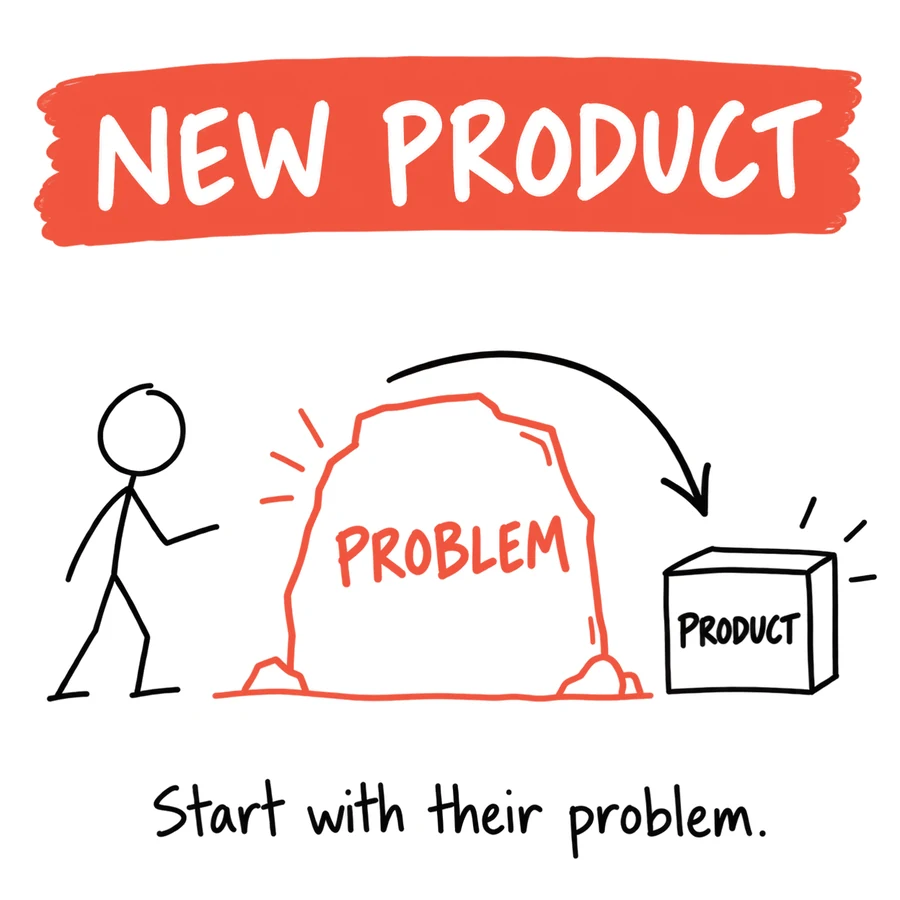
Hand drawn sketch titled New Product. A stick figure walks toward a large boulder labelled Problem, and an arrow arcs over it to a box labelled Product. Caption: Start with their problem.

McKesson was launching a managed services bet with a new leadership team and a fixed deadline: HIMSS, where their buyers, hospital CIOs, would be in one building for three days. They launched with a message that landed with those CIOs. Paula Cobb, their marketing leader, put it this way: “We had people both internally and externally to McKesson that really understood what we were trying to say, and it made so much sense.”

You can’t afford to go to market twice. Especially when the market is in one building for three days.

See the McKesson story →

Is this you?

  • Launch is inside a quarter away and the messaging brief is a feature list.
  • Product, marketing and sales each describe the new product’s buyer differently.
  • The launch deck opens with the product.
  • Nobody can say what the buyer does today instead of buying this.
  • Sellers are asking which of the existing decks the new product goes into.

WHAT THE PROBLEM COSTS

Lead with the product and you lose on the product

A launch that leads with features puts your newest thing into the oldest contest there is: compared line by line, then discounted.

18%

Sellers who lead with product features, price, and discounts win only 18% of their deals, the lowest win rate of the four strategies studied.

Source and our read

64%

64% of B2B buyers cannot distinguish one brand’s digital experience from another’s.

Source and our read

10%

Two days after a presentation, people remember about 10% of it. Dr. Carmen Simon’s studies put the range at 3% to 12%, and when the presenter leaves it to chance, which part survives is random. The report treats 10% as a rule of thumb across its studies, not a single measurement.

Source and our read

17%

When B2B buyers are considering a purchase, they spend only 17% of that time meeting with potential suppliers. When they are comparing multiple suppliers, the time spent with any one sales rep may be only 5% or 6%.

Source and our read

See every figure, graded by source →

WHY NOW

Launch day does not move

The date is set by a conference, a fiscal year, or a promise already made to the board. Work backward from it. Sellers need the story before launch day, because the first buyer question arrives the same morning as the press release.

And the first version sticks. Analysts write it down, early customers repeat it, and your own team learns it. Relaunching a story costs more than launching one, because now you are arguing with your own first impression.

THE OUTCOME

Launch day, and everyone says the same thing

Picture launch day with the story settled. The keynote opens with the buyer’s problem. The web page, the press release and the first sales call all name the same problem and the same outcome, and the product arrives as the way through. A CIO who hears it on Tuesday can repeat it to their CFO on Wednesday.

Your sellers got the story weeks earlier and helped shape it, so they are telling it rather than reading it. You go to market once.

THE PATH

Position it outside-in, then give it a spine

Start in the buyer’s world. What is the problem this product exists for, in the buyer’s words? What are they doing about it today, including nothing? Who feels it enough to act? What category will they file you under, and is that the one you want? What is it worth in their dollars? Then the inward question: what can this product do that the alternatives cannot?

Then the narrative spine: Problem, Outcome, Path, Steps. The product shows up in the Path, as the way through, which is when a buyer is ready to hear about it.

Then test it on real buyers before the launch does it for you, and align every surface to it: the keynote, the web page, the first-call conversation, the demo.

THE STEPS

Three steps, two of them this week

  1. Check the three teams

    Have your product, marketing and sales leaders take the Narrative Assessment separately. Seventeen questions, five minutes each. Where their answers split is where the launch story will split.

    Take the Narrative Assessment

  2. Run the alternatives test

    Ask the launch team what a buyer does today instead of buying this, including nothing. If the room cannot agree, the positioning is not done.

  3. Tell me the launch date

    The product, the buyer and the date. I will tell you what can be done in the time you have.

    Start the conversation →

QUICK ANSWERS

Questions we get

When should positioning start for a new product?

Earlier than feels necessary. Positioning decides who the product is for and what it gets compared against, and those choices shape pricing, packaging and the launch plan. Done in the last few weeks, it can only describe decisions already made. If launch is close, do it anyway: a late clear story beats an on-time feature list.

How is positioning different from launch messaging?

Positioning is the set of choices underneath: the market, the alternatives, the buyer, the category, the value, and what only you can do. Messaging is how those choices get said. When the messaging keeps getting rewritten and never lands, the choices were usually never made.

Does a new product need its own story, or does it fit the company story?

It hangs from the company story. The company narrative is the spine, and a product story is one way of telling it to one buyer. A product that cannot hang from the company narrative is telling you something: either the product is off strategy, or the company story is due for an update.