
Inspire Your Buyers®

SCENARIOS · NEW REVENUE LEADER

You inherited the number. You also inherited the story.

Every new revenue leader gets a target and about a hundred days of goodwill. Most spend them on pipeline reviews, territories and tools. What is missing the number usually sits upstream of all three.

THE PROBLEM

Ask five reps what makes you different

Here is a test for your first week. Ask five of your reps what makes the company different. Would you get five different answers, and would any of them be right? Then ask your leadership peers. Then read the website.

What you usually find is a team working hard in different directions. Marketing built a story for the market, sales built one for deals, success built one for renewals, and nobody owns the one underneath. We call what the buyer feels Value Dissonance™: the clash when everyone representing you describes your value differently.

It shows up on your dashboard as stalled deals and discounting, so it gets treated with coaching and a new sales process. That is painkillers for a misaligned spine.

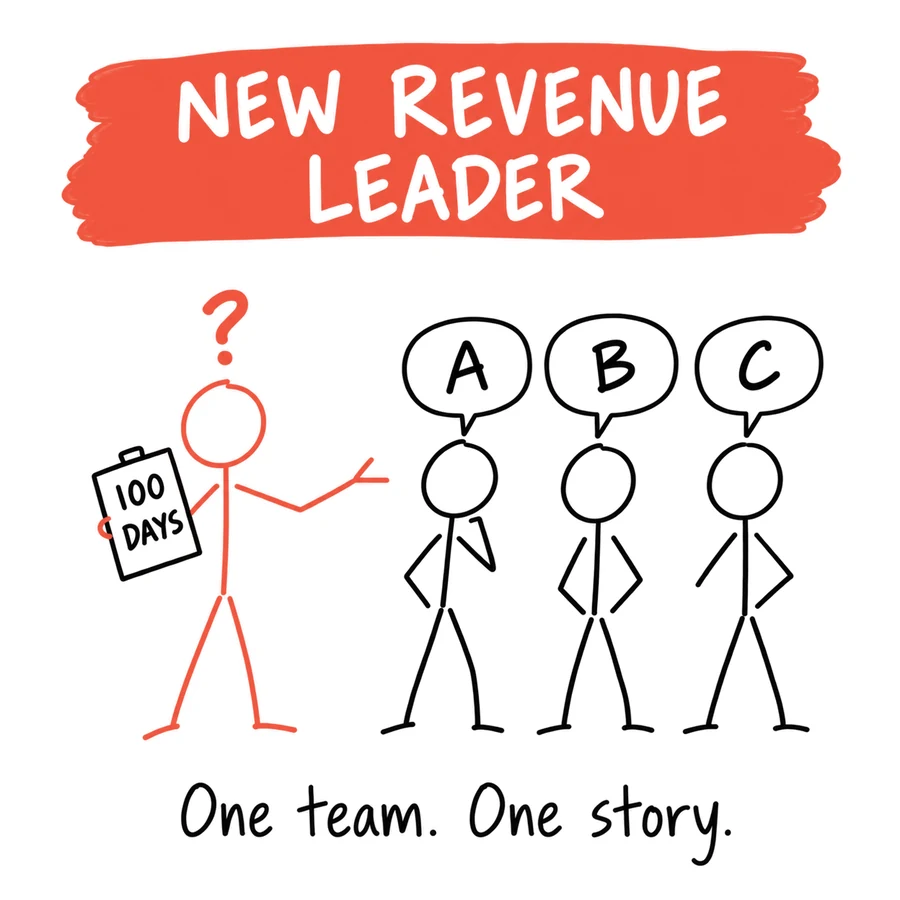
Hand drawn sketch titled New Revenue Leader. A new leader holding a clipboard marked 100 Days, with a question mark overhead, faces three team members whose speech bubbles say A, B and C. Caption: One team. One story.

IXIA had twenty-five senior go-to-market executives who couldn’t agree on one story, and a CMO tired of paying for help. He sent his VP of Marketing to learn the method and bring it in-house. She watched twenty-five people converge on three differentiating attributes in one session and told him it couldn’t be replicated without the room.

The framework is in the book. The room is the work.

See the IXIA story →

Is this you?

  • You have asked several leaders why buyers choose you and heard several answers.
  • Win rates are flat and the loss reasons say price or no decision.
  • Every team has its own deck, and sellers build their own on top.
  • Your first instinct is a new sales methodology.
  • The website and the sales conversation describe two different companies.

WHAT THE PROBLEM COSTS

The number you inherited is downstream of the story

An unclear story rarely shows up as a messaging problem. It shows up as the metrics you were hired to fix.

4%

Only 4% of companies surveyed reported a strong, clear and consistently understood value proposition. Companies with clear, consistently understood value propositions reported 19% revenue growth in 2025, compared with 12% for those with limited or inconsistently communicated ones. This is an association, not evidence that clarity caused the growth difference.

Source and our read

72%

When a strong seller loses, their manager blames a misaligned strategy, not poor execution, 72% of the time.

Source and our read

49%

Nearly half of companies say their biggest value proposition problem is core product or service differentiation. Bain calls that an existential issue, not a communications one.

Source and our read

69%

69% of B2B buyers report inconsistencies between the information on a company’s website and what its sellers tell them. Gartner’s own analysts warn this “creates mistrust, potentially putting the transaction at risk.”

Source and our read

See every figure, graded by source →

WHY NOW

The first hundred days are when you can still ask

A new leader has a short window in which basic questions are expected. Why do buyers choose us? Why do they not? What do we say we are? Six months in, those questions sound like you have not been paying attention. In the first hundred days they sound like leadership.

It is also when your peers will still come to the room. A shared story needs the heads of product, marketing, sales and success to build it together, and a new leader’s invitation is one people accept.

THE OUTCOME

Day one hundred

Picture your first board update. You can say why buyers choose you in one line, and so can every leader on your team, in the same words. Enablement trains one story. Marketing takes one story to market. A rep in their second week gives the same answer as your best seller.

The programs you were hired to run, the process, the territories, the tools, now have something solid to stand on. And the story is yours. You built it with the team, early, when you still could.

THE PATH

Adjust the spine before you add muscle

Before the reorg, the new methodology or the new tech stack, get the positioning right. The work runs outside-in: the market you are in, what buyers do instead of buying from you, who feels the problem and can act, the category you belong in, the value in the customer’s dollars. Then the one inward question: what can you do that the alternatives cannot?

Then one narrative spine, Problem, Outcome, Path, Steps, built in the room by the leaders who have to stand behind it. Nobody defends language they were handed. They defend what they helped build.

Then everything you were going to do anyway works harder. Enablement has one story to train. Campaigns have one story to take to market. Your forecast calls stop being an argument about what the company does.

THE STEPS

Three steps, two of them this week

  1. Get a baseline

    Have your leadership team take the Narrative Assessment separately. Seventeen questions, five minutes each. The spread between their answers tells you how much of the number is a story problem.

    Take the Narrative Assessment

  2. Ask five reps

    Ask five reps what makes you different. Write down the answers word for word. Bring them to your next leadership meeting without commentary.

  3. Tell me what you inherited

    The team, the number, and how many days in you are. I will tell you what the work would look like.

    Start the conversation →

QUICK ANSWERS

Questions we get

Should a new CRO or CMO start with positioning or with pipeline?

Pipeline will not wait, so both. But put positioning inside the first hundred days, because every pipeline fix you make is built on it. Territory plans, enablement and campaigns all assume a story. If the story is unclear, each of those programs scales the confusion.

I run sales, not marketing. Is positioning my job?

It is your number. Bain & Company’s 2026 B2B Growth Agenda found that only 4% of companies have a clear, consistently understood value proposition, and that those companies grew 19% in 2025 against 12% for companies with limited or inconsistent ones. Whoever owns positioning on the org chart, the revenue leader pays for its absence. The work needs sales, marketing, product and success in the same room, and a new leader is often the only person who can call that meeting.

What if the last narrative project failed?

Many do, usually for one of two reasons. It was written by a small group and handed to everyone else, so nobody defended it. Or it was never tested on buyers, so the first senior skeptic killed it. Build it in the room and test it outside the building, and it survives both.