Inspire Your Buyers®

SCENARIOS · NEW PLATFORM OR PORTFOLIO

A catalog is not a story.

You built it, bought it, or bundled it, and now you sell a portfolio or a platform. Each product has its own pitch. The buyer still wants to know one thing: what do you do for a company like mine?

THE PROBLEM

Sellers pitch the part they know

Growth adds products faster than it adds story. Each new product arrives with its own deck, its own specialist and its own way of describing the customer. Sellers default to the one they know best. A buyer meets three of your people and hears about three companies.

Calling it a platform does not fix it. A platform story that is a list of products with an architecture diagram on top still asks the buyer to work out how the parts add up to something they need. The parts are yours. The sum has to be theirs.

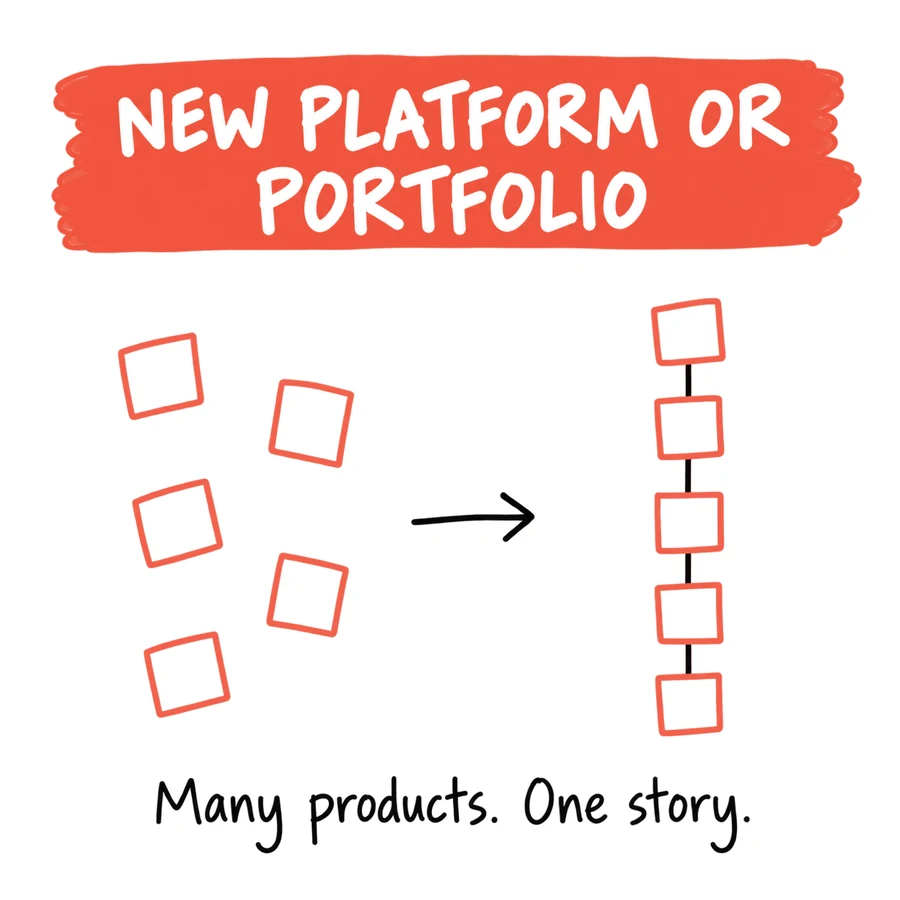
Hand drawn sketch titled New Platform or Portfolio. Five loose squares tumble on the left. An arrow leads to the same five squares threaded in a neat column onto one vertical line, like vertebrae on a spine. Caption: Many products. One story.

Alcatel-Lucent’s enterprise sellers were pitching 460 products and the market was confused. We named the problem “moving too slow,” made the outcome the Dynamic Enterprise, and organized 460 products into four categories a seller could hold in one hand. After launch, 97% of surveyed buyers said they clearly understood the solutions and 86% understood the value. It won CEB’s B2B Marketing Campaign of the Year and held for close to a decade.

CSC had practice areas across several business units, each saying something different. We found the customer challenge that cut across all of them and landed one big idea: easy to use, easy to manage, easy to innovate. Sales got a bigger conversation than any single practice could hold.

See the Alcatel-Lucent story →

Is this you?

  • Your overview deck has a slide per product.
  • Sellers lead with the product they were hired to sell and rarely cross-sell.
  • Buyers say “I didn’t know you did that.”
  • The word platform is on the website and nobody can say, in one line, what it does for a buyer.
  • Deals are product-sized and land with product-level buyers.

WHAT THE PROBLEM COSTS

More versions of you, smaller deals

A buying group has to agree. Every extra version of you gives them one more thing to disagree about.

153%

Buyers hit with too much contradictory information are 153% more likely to settle for a smaller, less disruptive purchase than they originally planned.

Source and our read

74%

74% of B2B buying teams demonstrate “unhealthy conflict” during the decision. Buying groups ran from five to 16 people across as many as four functions, and groups that reached consensus were 2.5x more likely to report a high-quality deal.

Source and our read

59%

Content tailored to individual stakeholders has a 59% negative impact on buying group consensus. Content relevant to the whole group improves consensus by 20%, and buyers who experience group relevance are three times more likely to report a high-quality deal.

Source and our read

39% less

Top-performing sellers spend 39% less time on features and technical topics than average sellers, and 52% more time on business and value topics. The comparison is top sellers against average ones, not won deals against lost ones.

Source and our read

See every figure, graded by source →

WHY NOW

The portfolio grows faster than the story

Every release, acquisition and partnership adds another pitch. Left alone, the gap between what you sell and what your sellers can explain widens each quarter. The bigger deals, the ones that need several products together, are the first to go.

It also sets your ceiling. A seller who can only tell a product story gets a product-sized deal with a product-level buyer. The platform conversation happens higher up, and it needs a story that belongs there.

THE OUTCOME

One story, and every product has a home in it

Picture a specialist and a generalist walking into the same account a week apart. Both open with the same problem and the same outcome. One goes deep on their part of the path, the other covers the whole, and the buyer hears one company.

The overview fits on one page a seller can draw. Buyers stop saying “I didn’t know you did that.” The deals that need several products together now have a story that belongs in the room where they get approved.

THE PATH

Find the problem that cuts across everything

A portfolio story does not come from summarizing the products. It comes from the customer challenge that runs underneath all of them. We look outside first: the market, what buyers do today without you, who feels the problem and can act, the category, the value in their dollars. Then inward, at what the whole can do that no single product, and no competitor’s point product, can.

Then the narrative spine: Problem, Outcome, Path, Steps. One big problem, one outcome, and a Path with few enough parts that a seller can hold them in one hand. Every product gets a home in that Path. If a product has no home, that tells you something too.

Then the product stories get rebuilt as chapters of the one story, so a specialist and a generalist can walk into the same account and sound like the same company.

THE STEPS

Three steps, two of them this week

  1. Count your stories

    Have the leader of each product line take the Narrative Assessment separately. Seventeen questions, five minutes each. The differences between their answers are the differences your buyers hear.

    Take the Narrative Assessment

  2. Try the one-hand test

    Ask three sellers to sketch everything you sell on one page, from memory. Put the drawings side by side.

  3. Tell me what you sell now

    The products, how they arrived, and who sells them. I will tell you what the work would look like.

    Start the conversation →

QUICK ANSWERS

Questions we get

What is the difference between a product story and a platform story?

A product story says what one thing does. A platform story says what becomes possible for the buyer when the things work together, and it starts with a problem too big for any single product to claim. If your platform story can be told by reading the product list aloud, it is still a product story.

Do we have to drop our product messaging?

No. Product stories stay, as chapters. What changes is that each one starts from the same problem and outcome as the company story, then goes deep on its part of the path. Specialists keep their depth. Buyers stop hearing different companies.

How many categories should a portfolio be grouped into?

Few enough to hold in one hand. At Alcatel-Lucent, 460 products became four categories. The test is whether a seller can draw it from memory and a buyer can repeat it to a colleague the next day.