Inspire Your Buyers®

SCENARIOS · NEW STRATEGIC PARTNERSHIP

Announced on Monday. Strategic in name only by Q3.

Two companies shake hands, the announcement goes out, and both sides go back to their own quotas. A partnership lives or dies on whether someone else’s sellers can tell your joint story when you are not in the room.

THE PROBLEM

Partnership Drift

It is common to announce a strategic partnership and then watch it slide into quarters of alignment meetings with little joint pipeline to show for it. I call it Partnership Drift: leaders agree on intent, and execution never activates.

The cause sits upstream of enablement. The two companies never settled on a joint value proposition a buyer cares about. Each side describes the partnership in terms of its own product. The partner’s sellers get a folder of assets and a product training, and still cannot explain, in an executive conversation, why the two of you together beat either of you alone. Sellers sell what they can explain, so they go back to selling what they know.

A partner’s seller is the purest test of a narrative there is. They do not work for you, nobody pays them to learn your story, and you will never be in the room when they tell it.

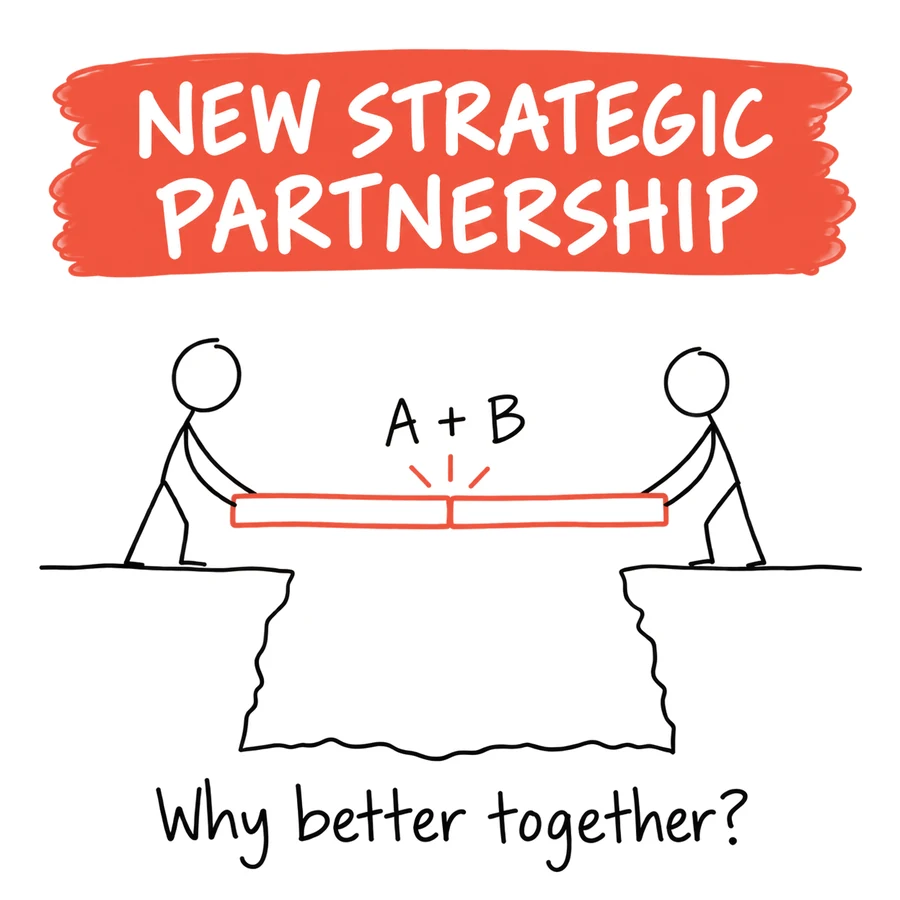
Hand drawn sketch titled New Strategic Partnership. Two stick figures on opposite cliffs each hold a plank, and the planks meet over the gap under the label A plus B. Caption: Why better together?

I have led award-winning strategic partner go-to-market work for HP and Microsoft, Microsoft and Fujitsu, Teradata and SAS, CSC and Google, CSC and Oracle, Microsoft and Infosys, and CSC and IBM.

The lesson I took from them: when partners can’t defend why the partnership matters, and sellers can’t defend why buyers should change, the safest outcome is inaction.

Is this you?

  • The partnership was announced more than a quarter ago and there is no joint pipeline to point at.
  • Each company describes the partnership in terms of its own product.
  • Partner sellers have the assets and still do not bring you into deals.
  • The partner’s leadership has not funded enablement or committed seller time.
  • Nobody can finish the sentence “together we” in a way a buyer would care about.

WHAT THE PROBLEM COSTS

Twice the storytellers, half the control

A partnership doubles the number of people telling your story and halves your say in how it gets told. Buyers were already hearing mixed messages from one company.

17%

When B2B buyers are considering a purchase, they spend only 17% of that time meeting with potential suppliers. When they are comparing multiple suppliers, the time spent with any one sales rep may be only 5% or 6%.

Source and our read

69%

69% of B2B buyers report inconsistencies between the information on a company’s website and what its sellers tell them. Gartner’s own analysts warn this “creates mistrust, potentially putting the transaction at risk.”

Source and our read

153%

Buyers hit with too much contradictory information are 153% more likely to settle for a smaller, less disruptive purchase than they originally planned.

Source and our read

74%

74% of B2B buying teams demonstrate “unhealthy conflict” during the decision. Buying groups ran from five to 16 people across as many as four functions, and groups that reached consensus were 2.5x more likely to report a high-quality deal.

Source and our read

See every figure, graded by source →

WHY NOW

Partner attention has a half-life

Your partner has other partners. Their leaders fund what is producing pipeline, and their sellers lean toward what is easy to sell. The weeks after the announcement, when both sides are paying attention, are the cheapest moment you will ever get to set the joint story.

Let it stretch into quarters and the attention moves on. Restarting a drifted partnership means winning the partner’s leaders back first, and now they have evidence that it did not work.

THE OUTCOME

Their seller tells it as well as yours

Picture a partner seller in an executive meeting you did not know was happening. They open with the buyer’s problem, show the outcome, and lay out a path in which both companies have a clear part. The buyer hears one solution with two names on it.

Upstream, the partner’s leaders can say why this partnership gets priority, in their own numbers, so it gets funded and staffed. Joint pipeline shows up in weeks rather than quarters, because sellers on both sides are telling a story they can explain.

THE PATH

Why change, why now, why together

Position the joint offering the way you would position a company, from the outside. What problem does the buyer have that neither of you solves alone? What are they doing about it today, including nothing? Who feels it and can act? What category does the combined solution belong in? What is it worth in the buyer’s dollars? Then look inward, at both companies: what can the two of you do together that no one else can?

Then one narrative spine, Problem, Outcome, Path, Steps, built with leaders from both companies in the room. The partner is written into the storyline, not added as a logo at the end. Nobody defends language they were handed, and a partner will defend yours least of all.

Then quantify it twice. Once for the partner’s leaders, who need a reason to give this partnership priority: pipeline, margin, services, retention. Once for the buyer’s CFO, who needs the economics of the total solution. Then test it with real buyers and align both companies’ surfaces to it.

THE STEPS

Three steps, two of them this week

  1. Start with your own story

    Have the leaders who own the partnership on your side take the Narrative Assessment. Seventeen questions, five minutes each. A joint story cannot be clearer than your own, so find out how consistent yours is.

    Take the Narrative Assessment

  2. Ask the why-together question

    Ask your alliance lead and theirs to finish the sentence “together we” for a buyer. Separately, in writing. Put the two answers side by side.

  3. Tell me who you partnered with

    The two companies, the joint offering, and how long since the announcement. I will tell you what the work would look like.

    Start the conversation →

QUICK ANSWERS

Questions we get

Why do strategic partnerships stall after the announcement?

Most stall because the two companies never agreed on a joint value proposition buyers care about. Partner sellers cannot explain the total solution, and partner leaders cannot justify the investment. The partnership stays strategic in name only. I call it Partnership Drift.

Is this partner enablement?

It is what partner enablement is usually missing. Most programs ship product training and assets. Sellers execute what they can explain, and what they need to explain is the joint story: why change, why now, why together. Enablement built on that story works. Enablement built without it is a folder nobody opens.

Who should be in the room?

The leaders at both companies who own the relationship, the offering and the selling: alliances, product, marketing and sales on each side. The story has to survive two organizations, so both have to help build it.