Start with the buyer
Connect the customer’s priorities and current situation to the value drivers that matter for this decision.

ValueNavigator
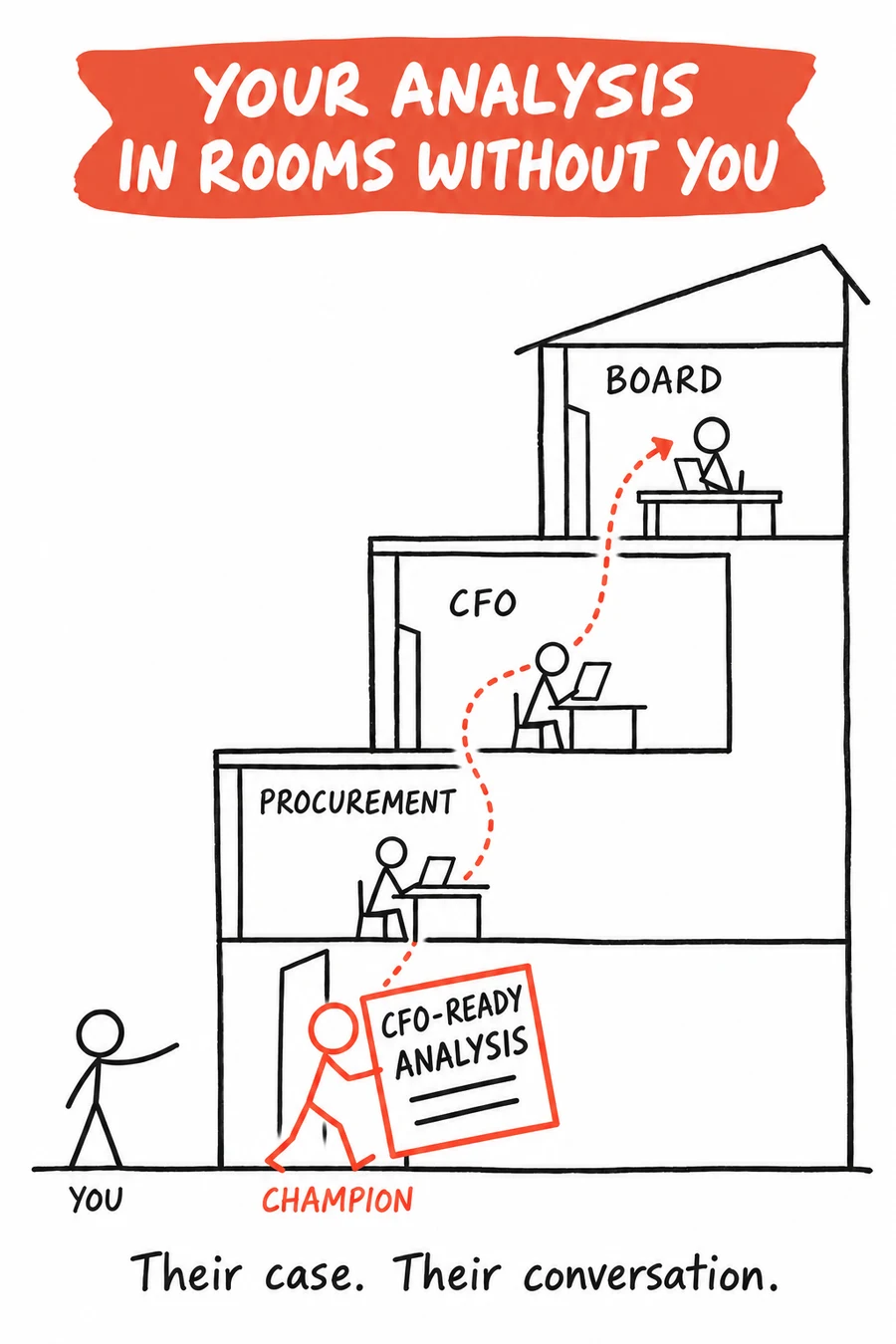
Give your champion a clear case for change. Give Finance assumptions they can see, numbers they can question, and a decision they can evaluate.
This is not your typical vendor black-box tool. This is something your buyers can use in rooms you won't be in.

One connected case.
From the first estimate to the approval conversation.
The approval conversation
Your champion sees the value. The people approving the investment still need a case they can examine.
ValueNavigator connects the ROI model, value calculator, and business case in one workflow. Assumptions are visible, inputs are editable, and sources are linked. The buyer can review the logic with Finance and Procurement and make the case their own.
The workflow
Identify the stakeholders, Finance criteria, risk triggers, and what a defensible case needs to look like for this buyer.
Make “later” measurable. Show the buying team what it costs to keep the current approach, from missed revenue to avoidable costs and risk.
Turn value drivers into explainable math. Make assumptions visible, connect them to relevant benchmarks, and validate the inputs with your buyer.
Compare conservative through optimistic cases so Finance can challenge the assumptions and the champion can explain the range of outcomes.
Help the champion circulate the case, answer hard questions, and update assumptions as more stakeholders review the decision.
What is included
Connect the customer’s priorities and current situation to the value drivers that matter for this decision.
Review the sources, adjust the inputs, and test the scenarios behind the financial analysis.
Give the buyer a CFO-ready analysis they can explain, circulate, and defend with the people approving the investment.
Try it with your next buyer
Start with a real customer and a real decision. Use the trial to explore the value drivers, review the assumptions, and see how a business case takes shape.
Where it fits
Buyers explore value on your website and develop a preliminary case before speaking with Sales. The conversation starts with context.
After discovery, sellers and buyers build a tailored case together and equip the champion for internal review.
Website inputs carry forward into the deal, so the case develops as the conversation progresses without starting from scratch.
The buying context
Independent research on buying decisions, self-service evaluation, and financial scrutiny.
of deals end without a decision, according to the research behind The JOLT Effect.
of surveyed B2B buyers preferred a fully digital, self-service buying experience. Gartner surveyed 645 buyers in August and September 2025.
Source: Gartner, May 2026
of business buyers use trials to evaluate potential solutions, according to Forrester. This includes paid sandboxes and usage-based trials.
of respondents in G2’s 2024 software buyer survey said the CFO always or frequently held final decision-making power.
Source: G2, 2024 Buyer Behavior Report
One case, connected parts
AI and human judgment
AI can help with research, benchmarking, draft models, scenario variations, and executive summaries. It can also help identify inconsistent assumptions and places where an explanation is unclear.
The buyer and the people doing the work still validate the sources, assumptions, and financial logic. The goal is a case the buyer understands well enough to defend.
Quick answers
Clear assumptions, cited benchmarks, explainable math, and a range of scenarios. Finance needs to see where the inputs came from, what could change, and how those changes affect the case.
Cost of inaction is what the business continues to lose by staying with its current approach. It can include missed revenue, avoidable costs, lost productivity, risk exposure, and strategic delay. Making those costs visible helps the buyer evaluate the decision to wait.
A business case is the decision document used to justify a change. It connects the problem and desired outcomes with financial impact, key assumptions, costs, and risks so stakeholders can evaluate the investment together.
ROI compares the net benefits of a change with the investment required. A defensible model makes benefits, costs, timing, and assumptions explicit, then tests different scenarios so the buyer and Finance can review the logic.
A value calculator helps a buyer estimate potential value early. ValueNavigator connects that estimate with the inputs, benchmarks, and assumptions needed to develop a business case for internal review. A website calculator is an optional part of the offering.
Start with the buyer’s context and approval requirements. Quantify the cost of inaction and value drivers, validate the assumptions and benchmarks, compare scenarios, and assemble an executive-ready case. AI can help with early drafts; the buyer and the people doing the work still need to validate the final logic.
Working with Inspire Your Buyers
Inspire Your Buyers is a strategic partner to ValueNavigator. The ValueNavigator team runs the technology. We frame the value analysis so the business case tells the same story as the narrative, support seller adoption, and stay involved in client success.
For the broader narrative work, see how Inspire Your Buyers works. If you joined the Tech Week session, the takeaway resources are all in one place.
The next step
Start your free trial of ValueNavigator and put the financial case behind your value story.
“Book time with me. I love showing it! I’ve been building business analysis tools for 25 years, and this blows me away!”
Bruce Scheer, Inspire Your Buyers